

The convicted party may lose the opportunity to review the judgment before the Court of Cassation due to a procedural error or failure to comply with the legally prescribed deadline. Therefore, the cassation appeal process begins by verifying that all legal requirements are satisfied and identifying the legal grounds upon which the appeal can be based.
Cassation Appeal Under Kuwaiti Law is a legal procedure used to review final judgments that are permitted by law to be challenged, by examining whether the legal rules and procedures that affected the judgment were correctly applied.
This stage requires a careful legal review, as a Cassation Appeal Lawyer in Kuwait helps review the judgment and its reasoning, identify possible grounds for cassation, and prepare the appeal petition according to legal requirements.
Do you need to understand the legal position of a judgment and the possibility of challenging it before taking any action?
Attorney Fahad Ahmed Al-Saeed explains the procedural aspects related to cassation appeals, starting from reviewing the judgment and identifying the grounds for appeal to preparing the appropriate legal approach.
What Is a Cassation Appeal Under Kuwaiti Law?
A cassation appeal under Kuwaiti law refers to the procedure through which a party challenges a final judgment that the law allows to be appealed before the Court of Cassation, with the purpose of reviewing whether the judgment complies with the correct legal rules.
The role of the Court of Cassation differs from that of trial courts, as it does not reconsider the case from the beginning and does not examine the dispute as a third level of litigation. Instead, it reviews legal errors that may affect the validity of the judgment. This differs from other appeal methods, such as the petition for reconsideration, which is related to specific legal cases for reviewing final judgments.
The purpose of a cassation appeal is to ensure the correct application of the law, not to reassess evidence or replace the trial court’s evaluation of facts.
Requirements for Accepting a Cassation Appeal Under Kuwaiti Law
Lack of satisfaction with a judgment alone is not sufficient for accepting a cassation appeal, as this legal remedy is subject to conditions and procedures established by the Kuwaiti Civil and Commercial Procedures Law. These requirements include the method of filing the appeal, the information required in the petition, the appeal deadline, and the grounds relied upon.
These requirements are connected to whether the appeal satisfies the legal conditions that allow it to be presented before the Court of Cassation.
The Judgment Must Be Eligible for Cassation Appeal
The review of a cassation appeal begins by verifying that the challenged judgment is among the judgments that the law allows to be appealed before the Court of Cassation.
The issuance of a final judgment does not necessarily mean that it can be challenged through cassation. Therefore, the type of case, the authority that issued the judgment, and the nature of the judicial decision must be reviewed.
The Appeal Must Be Filed by a Party with Legal Capacity and Interest
The appeal must be submitted by a person who has legal standing in the case and has an existing legal interest in filing it.
Lack of legal capacity or interest may result in the appeal being rejected according to the procedural rules governing this matter.
Compliance with the Cassation Appeal Deadline
Compliance with the cassation appeal deadline is one of the most important formal requirements for accepting the appeal. The Kuwaiti Civil and Commercial Procedures Law sets the cassation appeal deadline at thirty days for judgments that may be challenged before the Court of Cassation. Exceeding this period results in the appeal being rejected on procedural grounds.
The calculation of this deadline follows the applicable procedural rules. Therefore, the date of issuing the judgment and the procedures related to its notification must be reviewed before preparing the appeal petition to ensure that it is submitted within the legally specified period.
What Are the Grounds for Cassation Appeal Under Kuwaiti Law?
A cassation appeal is based on the grounds specified in Article (152) of the Kuwaiti Civil and Commercial Procedures Law. These grounds relate to violations of legal rules, defects affecting the judgment, or procedural errors, including:
- Violation of the law, error in its application, or interpretation: This ground applies when the judgment violates a legal rule that should have been applied, when the law is applied incorrectly, or when a legal provision is interpreted in a way that does not correspond to its correct meaning.
- Invalidity of the judgment: A cassation appeal may be filed if the judgment contains a defect that affects its validity and compromises the soundness of the issued decision.
- Invalidity of procedures affecting the judgment: This includes cases where a procedural defect occurs in connection with the proceedings and such defect has affected the judgment reached by the court.
Cassation Appeal Procedures in Kuwait
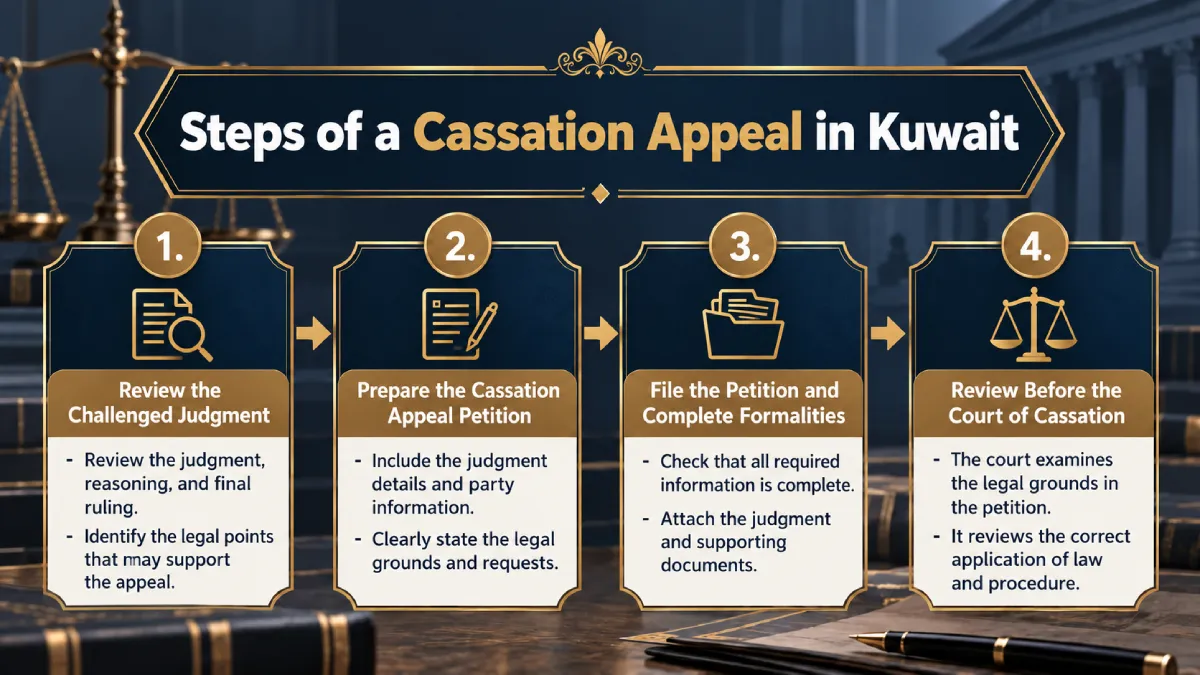
The cassation appeal procedures go through several stages, beginning with reviewing the judgment and ending with the examination of the appeal before the Court of Cassation. Therefore, preparing the case file requires arranging the steps according to the applicable legal requirements.
Reviewing the Challenged Judgment
The procedures begin with examining the judgment that is intended to be challenged and analyzing its reasoning and operative part. This review includes:
- The reasons supporting the judgment.
- The legal provisions relied upon by the court.
- The procedures followed during the hearing of the case.
- The legal points that may form the basis of the cassation appeal.
This stage does not focus on presenting the facts of the case again, but rather on identifying the legal error that can be submitted before the Court of Cassation.
Preparing the Cassation Appeal Petition
The cassation appeal petition is the main document through which the appellant explains the reasons for challenging the judgment. It must clearly include:
- Details of the challenged judgment.
- Details of the parties.
- The grounds of cassation appeal.
- The requests submitted to the court.
The drafting of the grounds of appeal is one of the most important preparation stages because the court examines the specific legal grounds presented by the appellant.
Filing the Appeal Petition and Completing the Procedures
After preparing the petition, it is submitted according to the prescribed procedures before the competent authority, along with the required documents.
The following must be verified:
- Completeness of the petition details.
- Attachment of the judgment and required documents.
- Fulfillment of the formal filing requirements.
Reviewing the Appeal Before the Court of Cassation
After completing the procedures, the Court of Cassation examines the grounds stated in the appeal petition and reviews the legal validity of the judgment.
The court does not rebuild the case from the beginning. Instead, it verifies the correctness of the application of law and the procedures upon which the judgment was based.
The court may conclude by rejecting the appeal or accepting the appeal and overturning the judgment, according to the applicable legal rules and depending on the nature of the case and the challenged judgment.
What Documents Are Required for a Cassation Appeal?
The documents required for preparing a cassation appeal file vary depending on the type of case and the nature of the challenged judgment. Therefore, the documents related to the case and the judgment must be reviewed before preparing the appeal petition.
The documents that a lawyer usually needs when reviewing a cassation appeal include:
- A copy of the challenged judgment.
- The cassation appeal petition prepared according to the legal requirements.
- Previous judgments related to the case when necessary.
- Documents that help demonstrate the legal violation.
- Documents proving legal standing or power of attorney according to the approved procedures.
Reviewing these documents helps build clear grounds for the cassation appeal and connect them with the challenged judgment, because the Court of Cassation examines specific legal issues and does not reconsider the dispute again.
Common Mistakes When Filing a Cassation Appeal
Some mistakes may affect the acceptance of a cassation appeal, including:
- Focusing on disagreement with the judgment instead of identifying the legal error.
- Submitting general grounds that do not specify the legal violation.
- Failing to review the legal deadline.
- Failing to organize the grounds of appeal clearly.
- Relying only on the facts of the case without explaining the legal impact.
The importance of these points increases because the Court of Cassation examines specific grounds and does not conduct a complete reassessment of the dispute.
When Do You Need to Consult a Cassation Appeal Lawyer in Kuwait?
Cassation cases require a careful legal review due to their connection with specific formal conditions and procedures. Therefore, a Lawyer in Kuwait specialized in appeals can help examine the judgment and determine whether there are legal grounds that can be relied upon before preparing the cassation appeal petition.
The legal review includes:
- Studying the reasons and operative part of the judgment.
- Identifying legal errors.
- Assessing the possibility of establishing grounds for appeal.
- Reviewing previous documents and procedures.
Frequently Asked Questions About Cassation Appeal Under Kuwaiti Law
How long does a cassation appeal take in Kuwait?
The duration of a cassation appeal varies depending on the nature of the case, the procedures followed before the Court of Cassation, and the documents submitted in the appeal file. The review period depends on the circumstances of each case and the court’s procedures.
Can a person challenge any final judgment through cassation?
Not every final judgment can be challenged through cassation. The possibility of filing a cassation appeal depends on the type of judgment, the issuing court, and whether the law allows that judgment to be reviewed before the Court of Cassation.
What happens after the Court of Cassation accepts the appeal?
When the Court of Cassation accepts the appeal, it examines the legal grounds raised by the appellant and reviews whether there was an error affecting the judgment. The court may uphold the judgment or issue a decision according to the legal rules applicable to the case.
Is it possible to submit new evidence during a cassation appeal?
A cassation appeal generally focuses on reviewing legal errors and the correct application of legal rules rather than reconsidering facts or examining evidence again. The scope of review depends on the legal issues presented before the Court of Cassation.
Why should a lawyer review the judgment before filing a cassation appeal?
A legal review helps determine whether the judgment contains grounds that may support a cassation appeal and ensures that the petition is prepared according to procedural requirements. The lawyer examines the reasoning, legal arguments, and related documents before filing.
A cassation appeal under Kuwaiti law requires accurate legal preparation that begins with reviewing the judgment, identifying the grounds of appeal, and completing the required procedures. You can Schedule an Appointment with Attorney Fahad Ahmed Al-Saeed to review the judgment and assess the possibility of filing a cassation appeal according to the applicable legal rules.
Related Legal Articles:
Filing an Original Nullity Claim in Kuwait.
Disclaimer: The information provided in this article is intended for general legal awareness only and does not constitute legal advice for a specific case, nor does it create an attorney-client relationship or legal representation. Legal procedures and available options vary according to the circumstances of each case and the related documents.

A lawyer in Kuwait (Registration No. 3097) specializing in Court of Cassation cases, constitutional lawsuits, and litigation management. Through this personal platform, he provides precise and methodical legal explanations of litigation procedures and the principles of drafting legal memoranda. His aim is to provide readers with clear procedural knowledge to protect their rights and reduce the risks arising from procedural errors and missed legal deadlines