

Have you obtained a court judgment abroad but are unsure how to enforce it in Kuwait? Foreign Judgment Enforcement in Kuwait requires an enforcement order from the Court of First Instance, subject to the conditions laid down in the Civil and Commercial Procedures Law.
You may find it difficult to enforce a judgment even when it was issued in your favor, particularly if the legal requirements have not been met. This article explains the conditions for acceptance, the required documents, and the steps for filing an application, helping you identify the appropriate legal route for your judgment.
Are you concerned that your application to enforce a foreign judgment might be rejected because a document is missing or legal procedures differ between countries? Lawyer Fahad Ahmed Al-Saeed can assess the judgment’s legal status and identify possible obstacles, helping you understand what needs to be completed before filing a case and avoid steps that could delay your application.
Or continue reading to learn the conditions for acceptance and the enforcement procedure.
Is Foreign Judgment Enforcement in Kuwait Legally Permitted?
Yes. Kuwaiti law allows judgments and orders issued by foreign courts to be enforced after obtaining an enforcement order from the Court of First Instance, in accordance with Article 199 of the Kuwaiti Civil and Commercial Procedures Law, subject to any applicable judicial agreements.
Kuwaiti courts do not reconsider the merits of the original dispute. Instead, they examine whether the legal conditions for granting the foreign judgment enforceable effect in Kuwait have been met, in line with the Court of Cassation’s judicial principles published by Kuwait’s Ministry of Justice.
Before filing, the judgment creditor may also need to consider the effect of foreign law and relevant judicial agreements. An enforcement lawyer in Kuwait can review the judgment and help determine the appropriate legal course.
Foreign Judgment Enforcement in Kuwait: Legal Conditions
Article 199 of the Procedures Law sets out the conditions for Foreign Judgment Enforcement in Kuwait. The following table explains these conditions and what the court examines when considering an application:
| Legal Condition | What Does the Court Check? |
|---|---|
| Jurisdiction of the foreign court | Whether the judgment was issued by a court with jurisdiction under the law of the country in which it was rendered |
| Proper participation of the parties | Whether the parties were duly summoned and properly represented |
| Final and binding effect | Whether the judgment has acquired the force of res judicata under the law of the court that issued it |
| No conflicting Kuwaiti decision | Whether the foreign judgment conflicts with an earlier judgment or order issued by a Kuwaiti court |
| Public policy | Whether the judgment violates public policy or morals in Kuwait |
In addition to these conditions, the first paragraph of Article 199 establishes the principle of reciprocity, subject to an exception introduced by Law No. 38 of 2007.
The legislature exempted judgments rendered in favor of a Kuwaiti individual or legal entity from the reciprocity requirement when enforcement is sought against assets owned by a Kuwaiti individual or legal entity.
The parties’ legal status and ownership of the assets targeted for enforcement must therefore be examined to determine whether reciprocity applies to the case.
Procedure for Enforcing a Foreign Judgment in Kuwait
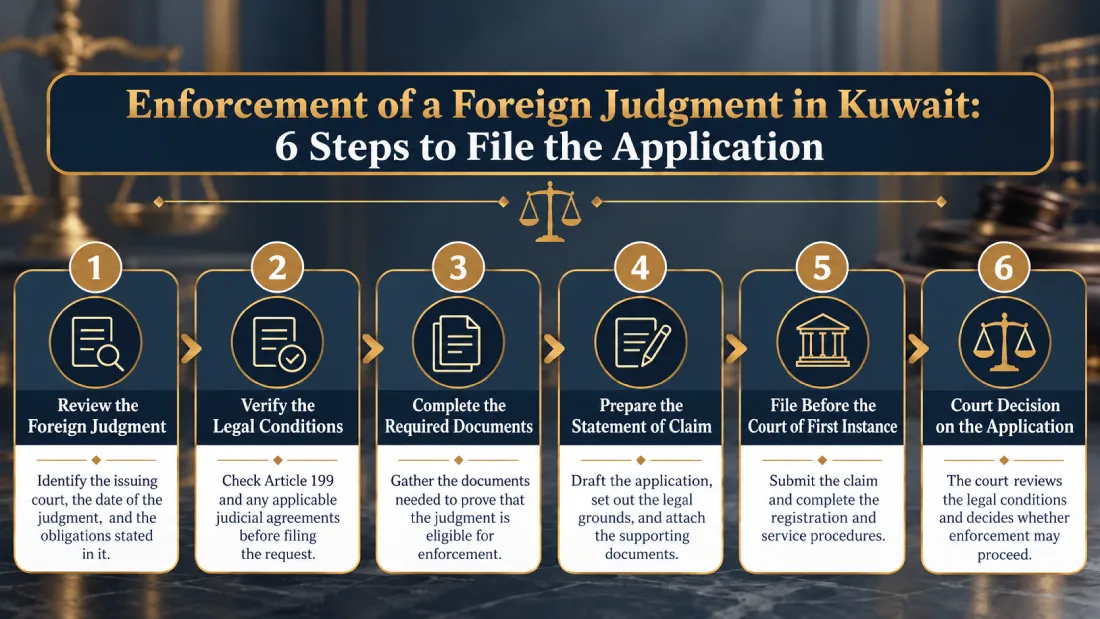
Foreign Judgment Enforcement in Kuwait begins with an application for an enforcement order from the Court of First Instance through the ordinary process for filing a lawsuit, pursuant to Article 199 of the Kuwaiti Civil and Commercial Procedures Law. This requires preparing a statement of claim and submitting documents supporting the enforcement application.
In practice, the application process can be organized into the following steps:
- Review the foreign judgment: Identify the issuing court, the date of the judgment, and the obligations stated in its operative part.
- Check the legal conditions: Determine whether the judgment satisfies Article 199 and any applicable judicial agreements.
- Complete the documentation: Collect the documents needed to establish that the judgment is eligible for enforcement, depending on the case.
- Prepare the statement of claim: Draft the request, set out its legal grounds, and attach supporting documents.
- File the case before the Court of First Instance: Submit the claim and complete the registration and service procedures in accordance with the applicable rules.
- Court determination: The court examines whether the enforcement conditions have been met and decides the case on the basis of the documents and legal arguments presented.
It is important to distinguish between obtaining an order to enforce a foreign judgment and actually recovering the amount or right awarded. An enforcement order allows enforcement proceedings to move forward in Kuwait, but it does not mean the claim will be recovered immediately.
Documents Required to Enforce a Foreign Judgment
The documents required for Foreign Judgment Enforcement in Kuwait vary according to the nature of the judgment, the country where it was issued, and the applicable judicial agreements. You should therefore review the available documents and make sure they meet the court’s evidentiary and filing requirements.
The main documents that an applicant may need include:
| Document | Purpose |
|---|---|
| Official copy of the foreign judgment | To establish the terms of the judgment and identify the issuing court |
| Proof that the judgment is final and binding | To establish the judgment’s legal status in the country where it was issued |
| Proof of service, where required | To establish that the proceedings were properly conducted, particularly for judgments issued in default |
| Certified Arabic translation, where required | To explain the content of documents written in another language |
| Required authentication or legalization, as applicable | To meet the requirements for accepting foreign documents |
| Civil ID or power of attorney | To establish the applicant’s identity and legal authority, or that of their representative |
The Kuwaiti Ministry of Justice explains the filing requirements through its Statement of Claim service, including the original claim and its copies, as well as a Civil ID or power of attorney as applicable.
Default judgments require particular attention to proof of service. Whether separate evidence of service is necessary must be assessed in light of the relevant judicial principles and the nature of the foreign judgment.
Reasons a Foreign Judgment May Be Refused Enforcement in Kuwait
An enforcement application may face difficulties because of missing or defective documents or a legal obstacle affecting the judgment itself. Identifying the reason for an objection helps determine whether additional evidence can resolve the issue or whether a fundamental legal condition has not been satisfied.
To reduce the risk of delays or refusal, consider the following reasons:
- Failure to prove the judgment is final and binding: There may be insufficient evidence that the judgment has acquired this status under the law of the issuing country. Review its legal status and obtain the necessary proof.
- Defects in the original proceedings: A party may not have been properly summoned or represented before the foreign court. Review the procedural documents carefully, especially where judgment was issued in default.
- Failure to establish the foreign court’s jurisdiction: Confirm that the court issuing the judgment had jurisdiction under the laws of its country.
- Conflict with an earlier Kuwaiti judgment: An earlier Kuwaiti judgment or order that conflicts with the foreign judgment may prevent enforcement from being granted.
- Violation of public policy or morals: A judgment may be denied enforceable effect if its content conflicts with public policy or morals in Kuwait.
Do Enforcement Conditions Differ Depending on the Country of Origin?
Yes. Some foreign judgments may be governed by judicial agreements regulating their recognition and enforcement, in addition to the rules in Kuwait’s Procedures Law.
For example, Kuwait has approved the GCC Convention on the Enforcement of Judgments, Judicial Delegations and Notifications. It also has judicial cooperation agreements with other countries, which may contain specific provisions on recognizing and enforcing foreign judgments.
These agreements do not necessarily cover every judgment issued in a contracting country. Their scope depends on the type of judgment and the terms of the relevant agreement. You can check the judicial agreements published by Kuwait’s Ministry of Justice.
Court Fees and Time Required to Enforce a Foreign Judgment in Kuwait
The time needed to decide an application for Foreign Judgment Enforcement in Kuwait depends on the circumstances of the case and any legal objections raised. It is therefore not possible to give a fixed timeframe that applies to every case.
Court fees are governed by Judicial Fees Law No. 17 of 1973, as amended, including Decree-Law No. 78 of 2025. Before filing, confirm the applicable fee for your application with the Judicial Fees Department at Kuwait’s Ministry of Justice.
How Can a Lawyer Help Enforce a Foreign Judgment in Kuwait?
The challenges of Foreign Judgment Enforcement in Kuwait are not limited to preparing documents. You may also need to identify the applicable law or address legal issues relating to the court that issued the judgment. A lawyer in Kuwait can examine these matters before the application is filed, reducing the risk of taking unsuitable procedural steps.
Legal assistance may include:
- Identifying the applicable judicial agreement: Checking whether an agreement exists between Kuwait and the country of origin and how its provisions affect enforcement.
- Assessing reciprocity: Determining whether the reciprocity requirement or its statutory exception applies, based on the parties’ status and the assets targeted for enforcement.
- Preparing the statement of claim: Drafting the requests and legal grounds to reflect the foreign judgment and the circumstances of the case.
- Responding to legal objections: Preparing responses to arguments about the foreign court’s jurisdiction or the legal conditions for enforcement.
- Following court decisions: Reviewing rulings and procedural decisions made during the case and identifying appropriate next steps as the proceedings develop.
Frequently Asked Questions About Foreign Judgments in Kuwait
Can a Default Judgment Issued by a Foreign Court Be Enforced in Kuwait?
Yes, a default judgment issued by a foreign court may be enforced in Kuwait if it meets the legal requirements set out in Article 199 of the Kuwaiti Civil and Commercial Procedures Law. The court must verify that the defendant was properly summoned and that the legal requirements concerning their representation before the foreign court were satisfied. Supporting documents must also be submitted, depending on the nature of the judgment and the procedures followed in the country where it was issued.
Must a Foreign Judgment Be Issued in Arabic?
No, a foreign judgment does not need to be issued in Arabic to be enforceable in Kuwait. However, submitting it to a Kuwaiti court may require a certified Arabic translation, along with the necessary authentication of foreign documents. It is advisable to check the documentation requirements before filing an enforcement case to avoid delays caused by missing translations or authentication.
Can a Foreign Judgment Be Enforced if the Judgment Debtor Resides in Kuwait?
Yes, a foreign judgment may be enforced in Kuwait if all legal requirements are met. However, the judgment debtor's residence in Kuwait alone does not guarantee that the enforcement request will be accepted. The court must verify that the foreign court had jurisdiction, that the judgment has acquired the force of res judicata, and that no legal grounds prevent it from being declared enforceable in Kuwait.
Does Appealing a Foreign Judgment Prevent Its Enforcement in Kuwait?
No, filing an appeal against a foreign judgment does not automatically prevent its enforcement in Kuwait. The outcome depends on the legal effect of the appeal under the laws of the country where the judgment was issued and whether the judgment has acquired the force of res judicata. Therefore, it is important to review the judgment's legal status and supporting documents before submitting an enforcement request to a Kuwaiti court.
Preparing for Foreign Judgment Enforcement in Kuwait begins with understanding the nature of the judgment and the effect of the law under which it was issued. The next step is to select the appropriate procedure under Kuwaiti legislation. The clearer the legal issues become, the better placed the judgment creditor will be to make an informed decision before going to court.
If you would like to know whether a foreign judgment can be enforced in Kuwait, you can book an appointment with lawyer Fahad Ahmed Al-Saeed to review your documents and explain the appropriate legal route for your situation.
Related Legal Articles:
Lifting a Travel Ban in Kuwait: When does it end, and what steps are required to lift it?
Legal Disclaimer: This article provides general legal information for awareness purposes only. It does not constitute advice tailored to your circumstances, and reading it does not create a lawyer-client relationship. Appropriate procedures vary according to the nature of the judgment, the country of origin, the available documents, and any applicable judicial agreements.

A lawyer in Kuwait (Registration No. 3097) specializing in Court of Cassation cases, constitutional lawsuits, and litigation management. Through this personal platform, he provides precise and methodical legal explanations of litigation procedures and the principles of drafting legal memoranda. His aim is to provide readers with clear procedural knowledge to protect their rights and reduce the risks arising from procedural errors and missed legal deadlines