
If your company’s bid has been disqualified from a government tender, or the contract has been awarded to a competitor despite irregularities in the evaluation process, an appeal against a Tender Committee decision may provide a legal means of challenging the decision and protecting your company’s interests. However, taking effective action starts with identifying the decision being challenged, the authority that issued it, and the grounds of the alleged violation, while observing the statutory deadlines for filing a complaint or grievance.
Tender disputes differ from other administrative disputes because they are governed by specific public procurement rules, as well as the terms and specifications set by the procuring entity. Reviewing the file with an administrative lawyer in Kuwait can help identify potential violations and determine the appropriate procedure, particularly where the decision results in a lost business opportunity or financial costs for the company.
Was your company’s bid disqualified, or was a tender awarded to a competitor despite irregularities in the evaluation? Do not let a short filing deadline put your rights at risk. Contact a licensed lawyer to review the decision and tender documents, assess the grounds for a challenge, and identify the appropriate legal action.
Request a Tender Decision Review
Or continue reading to learn about challenge procedures and deadlines.
When Can You Appeal Against a Tender Committee Decision in Kuwait?
A challengeable decision may arise at different stages of the tender process. It is not limited to bid rejection; it may also concern the award of a contract, the cancellation of a tender, or tender requirements that affect competing companies’ opportunities.
Decisions and procedures that may warrant a challenge include:
- Bid disqualification: Where the procuring entity rejects a company’s bid and there are grounds to review the reason for disqualification and its consistency with the tender requirements.
- Awarding the tender to a competitor: Where a company believes the award decision failed to follow the published criteria for comparing bids.
- Tender cancellation: Where questions arise as to whether the cancellation was based on legally recognized grounds and followed the prescribed procedures.
- Tender document requirements: Where the terms and specifications impose restrictions that may undermine equal opportunities for bidders.
It is important to understand that submitting the lowest price does not automatically entitle a company to win a tender. A bid must satisfy the technical requirements and published conditions, and bids must be evaluated against the approved criteria.
What Is the Difference Between a Complaint, a Grievance, and Court Proceedings?
Before filing an appeal against a Tender Committee decision, you must identify who issued the decision, its legal nature, and the authority responsible for reviewing it. Law No. 49 of 2016 on Public Tenders, as amended, distinguishes between complaints, grievances, and court proceedings, each with its own procedures.
The main differences are summarized below:
| Procedure | Competent authority | Scope of challenge |
|---|---|---|
| Complaint under Article 77 | The procuring entity, the head of the relevant entity, or the Central Agency, depending on the circumstances | Failure to comply with statutory obligations during procurement procedures |
| Grievance under Article 78 | Grievances Committee | Challenges to decisions issued by the Board of Directors of the Central Agency for Public Tenders |
| Court proceedings under Article 79 | Competent administrative court divisions | Disputes relating to public tenders and associated procurement operations |
First: Filing a Complaint Under Article 77
Article 77 allows a bidder affected by a competent authority’s failure to fulfil its statutory obligations to file a complaint during the procurement process. The complaint may concern an action taken by the authority or its failure to take an action required by law.
The complaint must be submitted in writing to the competent authority. It should identify the contested decision or action, set out the grounds for the complaint, and include supporting documents.
Complaints may also concern deficiencies in technical documents or general conditions where those deficiencies could undermine equality, fairness, or equal opportunities among bidders.
The authority to which the complaint is submitted depends on who was responsible for the contested action:
- If the entire procurement process falls within the procuring entity’s authority, the complaint is submitted to the head of that entity.
- If the action was taken by the Central Agency for Public Tenders or one of its committees, the complaint is submitted to the head of the Agency.
- If the challenge concerns a decision issued by the Agency, the complaint is submitted to its Board of Directors for determination.
Depending on the circumstances and its jurisdiction, the competent authority may suspend procurement procedures. The decision on the complaint must be issued in writing, state its reasons, and comply with the prescribed procedures.
Second: Filing a Grievance Under Article 78
A grievance differs from a complaint in both the competent authority and the nature of the decisions that can be challenged. Under Article 78, any interested party may challenge decisions of the Board of Directors of the Central Agency for Public Tenders before the competent Grievances Committee.
Important legislative update: Law No. 94 of 2026 amended certain provisions of Law No. 49 of 2016 on Public Tenders. It was published on September 27, 2026, and is due to take effect three months after publication.
Third: Taking Tender Disputes to Court
Under Article 79 of the Public Tenders Law, designated administrative divisions of the Court of First Instance have jurisdiction over disputes involving public tenders and related procurement operations.
When hearing such a dispute, the court examines whether the decision is lawful under the Public Tenders Law, its implementing regulations issued by Decree No. 30 of 2017, and the tender documents. This includes reviewing whether the procedures for disqualifying a bid, awarding a tender, or cancelling it were properly followed.
If continuing the procurement or award process could cause harm that would be difficult to remedy, the possibility of requesting interim judicial relief may be considered, subject to the applicable legal requirements. Filing a lawsuit does not, by itself, automatically suspend tender procedures. An appropriate application must be made, supported by reasons.
This specialized procedure differs from the general rules for challenging administrative decisions, discussed in our article on filing a grievance against an administrative decision in Kuwait. You should therefore identify the applicable special legal provisions and the competent authority before choosing how to proceed.
What Should You Do If Your Bid Is Disqualified or the Tender Is Awarded to a Competitor?
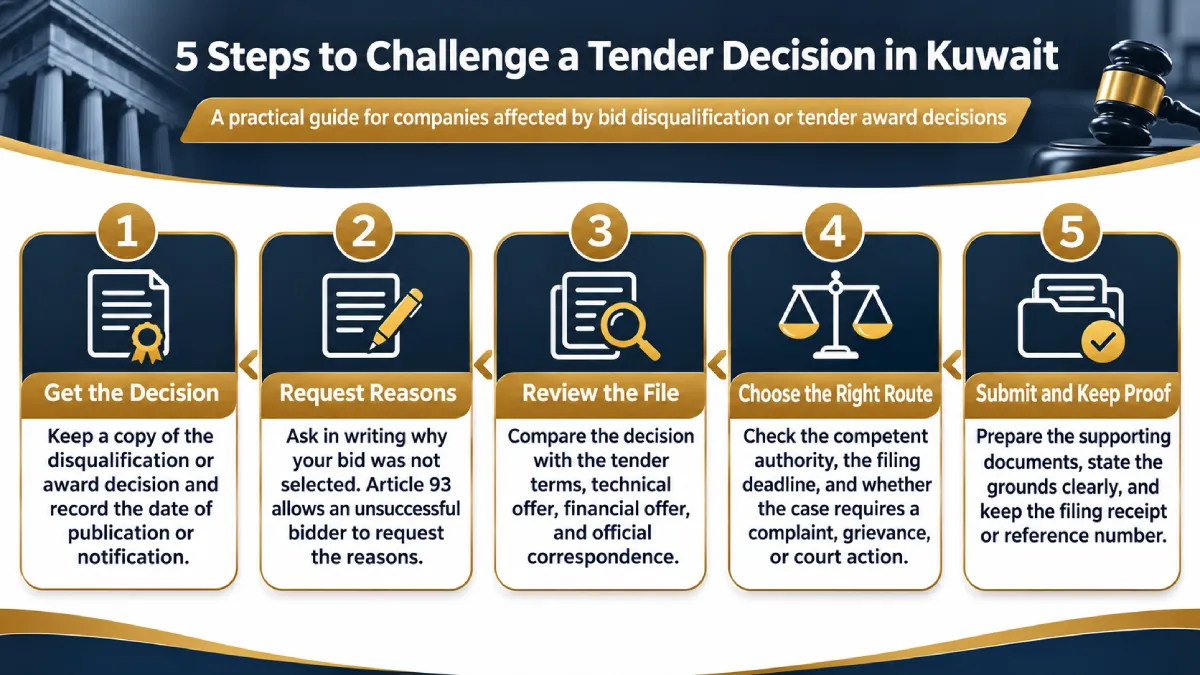
If your company’s bid is disqualified or the tender is awarded to a competitor, an appeal against a Tender Committee decision should be based on the authority’s stated reasons, not a general objection. Reviewing the decision and tender documents helps identify any potential violation and select the appropriate procedure:
- Obtain the decision and record its date: Keep a copy of the disqualification or award decision and record when it was published or when your company was notified.
- Request the reasons for not winning: Under Article 93, an unsuccessful bidder may request a written explanation of why its bid was not selected. The competent authority must provide that explanation within ten working days of the request.
- Review the tender file: Compare the stated reasons with the tender specifications, technical and financial proposals, and correspondence to identify any irregularity.
- Identify the appropriate route for challenging the decision: Check which authority has jurisdiction, which procedure applies, and the legal filing deadline. Do not wait for a response if doing so could cause the deadline to expire.
- Prepare your application and retain proof of submission: Clearly state the grounds and relief sought, attach supporting documents, and keep the filing reference number and proof of receipt.
Requirements for Submitting a Complaint to the Central Agency for Public Tenders
The Central Agency for Public Tenders has established procedures for complaints concerning procurement operations conducted through it, as explained in its notice to complainants and official complaint form, which set out the information, supporting documents, and submission requirements.
The main requirements include:
- Complete the complaint form with the company’s details, registration number, tender number, procuring entity, and subject of the complaint.
- Submit an official letter explaining the grounds for the complaint and attach supporting documents.
- Attach the signature authorization issued by the Agency for the person submitting the complaint.
- If the person submitting the complaint is not an authorized signatory, attach an authorization from the authorized signatory permitting that person to deliver the complaint and receive the filing receipt.
- Do not submit another complaint concerning the same subject and requests before the first complaint has been decided.
Legal Grounds for Challenging Tender Decisions
When preparing an appeal against a Tender Committee decision, identify the legal violation on which the challenge is based. Support it with a published tender condition or documentary evidence of a material irregularity in the procurement process.
Depending on the circumstances, possible grounds include:
- Breach of equality and equal opportunity: Where tender documents contain specifications that unjustifiably restrict competition, or the authority applies the requirements differently to competing bidders, contrary to Article 12 of the Public Tenders Law.
- Errors in the technical evaluation: Where a bid is disqualified based on an incorrect assessment of its compliance with the specifications or an alleged deficiency unsupported by the documents, taking into account the authority’s duty to identify deficiencies and violations under Article 49.
- Changing evaluation criteria after issuing the tender: Where the authority changes the evaluation factors or rules for comparing bids after the tender has been issued, contrary to Article 53 of the Public Tenders Law.
- Errors in bid ranking or contract award: Where the authority fails to apply the announced evaluation criteria when ranking bids or selecting the winning bidder.
- Failure to give reasons for disqualification or cancellation: Where the authority fails to explain the reasons for disqualification, award, or cancellation in accordance with Article 73, or cancels the tender without a legally recognized basis.
What Documents Are Required to Appeal Against a Tender Committee Decision?
Preparing an appeal against a Tender Committee decision requires reviewing the tender documents and comparing the reasons for the decision with the published terms and the submitted bid. This helps identify the legal violation that may support the challenge.
Key documents to prepare include:
| Document | Purpose |
|---|---|
| Tender announcement and number | Identify the procurement process and procuring entity |
| Tender specifications and conditions | Establish the requirements and evaluation criteria |
| Technical and financial bid | Compare the submitted bid with the announced requirements |
| Bid security or guarantee | Verify compliance with security requirements |
| Disqualification or award decision | Identify the contested decision and its reasons |
| Publication or notification record | Calculate the statutory deadline |
| Correspondence and clarification requests | Document the facts and official responses |
| Previous complaint or grievance | Prove the steps already taken by the company |
| Evidence of the company representative’s authority | Verify that the person filing the challenge is authorized to act for the company, where required. |
What Are the Deadlines for an Annulment Claim and the Court Fees?
Legal deadlines vary according to the procedure and the authority responsible for considering it. The following table summarizes the principal deadlines for complaints, grievances, and court proceedings, taking into account the effective dates of legislative amendments:
| Procedure | Deadline |
|---|---|
| Submitting a complaint under Article 77 | 7 days from publication or notification, whichever occurs first |
| Complaint about technical documents or general conditions that undermine equality | Until the deadline for submitting bids |
| Decision on a complaint | 7 working days from submission |
| Submitting a grievance under Article 78 | 7 working days from publication or notification, whichever occurs first |
| Decision on a grievance through December 26, 2026 | 7 working days from submission |
| Decision on a grievance from December 27, 2026 | 30 days from submission, with no award procedures to be undertaken during that period |
| Annulment claim under the general rules, where applicable | 60 days from publication, notification, or proven actual knowledge of the decision |
The 60-day deadline for an annulment claim should not automatically be applied to every tender dispute. The nature of the court application and whether the general rules apply must be verified, while distinguishing this period from the specific deadlines for complaints and grievances.
Court Fees
The following fees reflect the official legal text available as of November 3, 2026.
| Type of court application | Fee |
|---|---|
| Application to annul a decision | KWD 100 |
| Application to suspend enforcement | KWD 100 |
| Multiple decisions or applications | Fees apply separately according to the number of decisions and applications |
These fees are based on Article 11 of Law No. 20 of 1981 establishing the Administrative Division, as amended by Decree-Law No. 94 of 2024.
Fees for grievances submitted to the Grievances Committee are set by a decision of the competent minister under Article 89 of the Public Tenders Law. A complainant is entitled to a refund of the grievance fee if the grievance is upheld both procedurally and on its merits.
The applicable fee should therefore be checked when filing, and complaint or grievance fees should not be confused with court fees.
When Should You Hire a Lawyer to Challenge a Tender Decision?
Seeking assistance from a lawyer in Kuwait becomes particularly important when preparing an appeal against a Tender Committee decision involving a complex technical evaluation, an award to a competitor despite indications that the evaluation criteria were breached, or an approaching deadline for filing a complaint or grievance.
A company may need urgent legal advice if the award process has reached a stage where the effects of the decision would be difficult to reverse, or if the dispute requires assessing whether interim court relief can be sought.
After reviewing the tender decision, specifications, bids, and related documents, a licensed lawyer can assess the legal basis for a challenge, evaluate the impact of the alleged violation on the company’s position, and identify the appropriate procedure and relief to protect its interests.
The prospects of a successful challenge cannot be determined solely because a company’s bid was lower in price or was unsuccessful. They require a review of the facts, supporting documents, and relevant legal provisions.
Frequently Asked Questions About Challenging Tender Decisions
Does offering the lowest bid price give a company the right to win?
No. The lowest price alone does not guarantee a tender award in Kuwait. A bid must also satisfy the technical specifications and published conditions. An appeal against a Tender Committee decision should identify an error in how the announced evaluation criteria were applied, rather than rely solely on the proposed price.
May a bidder request an explanation for losing a public tender?
Yes. Under Article 93 of Kuwait's Public Tenders Law, an unsuccessful bidder may request written reasons explaining why its offer was not selected. The competent authority must provide those reasons within ten working days of the request. Keep a copy of the request and response for any subsequent challenge.
Will a complaint immediately stop the procurement process?
No. Filing a complaint does not necessarily stop the procurement process. Depending on the applicable procedure and its jurisdiction, the competent authority may decide to suspend it. Similarly, filing a lawsuit does not automatically halt a tender. A request for interim relief must be assessed separately under the relevant legal requirements.
Can bidders challenge unfair tender specifications early?
Yes. A bidder may raise a complaint about technical documents or general tender conditions that undermine equality or fair competition. Under the complaint procedure described in Article 77, objections relating to these deficiencies should be submitted before the bid submission period closes. The complaint should identify the contested provisions and provide supporting evidence.
An Appeal Against a Tender Committee Decision in Kuwait involves more than simply objecting to the tender outcome. It requires identifying a legal violation that affected the procurement process, reviewing the bid documents, and determining whether to file a complaint, submit a grievance, or initiate court proceedings based on the nature of the decision and the applicable deadlines.
If your company’s bid was disqualified, or the tender was awarded to a competitor despite a possible violation that warrants review, you can Contact Kuwait Lawyer about this guide with a licensed lawyer to discuss your case, review the tender documents, assess the legal grounds for a challenge, and select the appropriate action to protect your company’s interests before the deadline expires.
Related Legal Articles:
Annulment of an Administrative Deportation Order in Kuwait: grounds and procedures.
Disclaimer: This article is intended for general legal information only. It is not legal advice for any specific case and does not establish a lawyer-client relationship. Identifying the appropriate procedure requires reviewing the decision, supporting documents, applicable deadline, and the legal provisions in force when the action is taken.

Kuwait Lawyer is a legal information and guidance platform in Kuwait. It publishes plain-language articles and guides to legal procedures and relevant authorities.