

The process of filing an appeal in Kuwait begins before reaching the stage of drafting the appeal petition, because a judgment may contain several points that need to be reviewed before any procedural step is taken. Reviewing the judgment with an appeal lawyer in Kuwait can help clarify the legal position and determine the appropriate next step based on the content of the judgment, the legal positions of the parties, and the specific issues to be challenged.
In this article, Attorney Fahad Ahmed Al-Saeed explains the main matters that should be examined before filing an appeal, starting with determining who has the right to appeal and continuing through the procedures and scope of the dispute before the Court of Appeal.
Has a court issued a judgment against you, or did the judgment fail to grant all your requests, and are you concerned about losing your opportunity to appeal because of a procedural mistake or an expired deadline? Do not leave your legal position to chance. Attorney Fahad Ahmed Al-Saeed can review your judgment carefully, assess whether it is appealable, and examine the relevant deadlines and procedures before you take any step.
Or read the article first to learn about the main steps before filing an appeal.
Who Has the Right When Filing an Appeal in Kuwait?
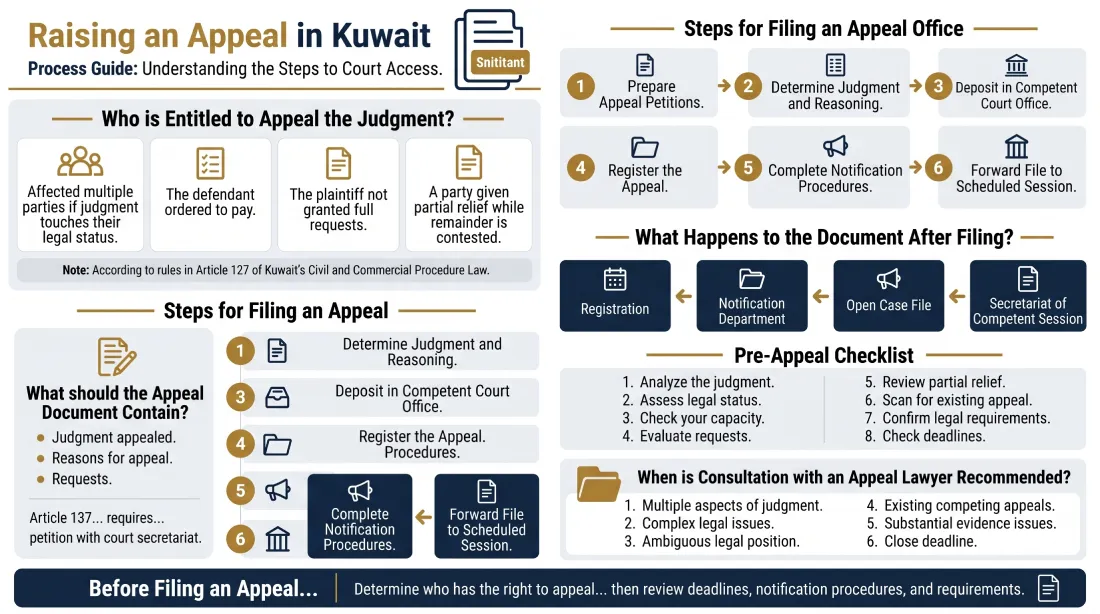
Dissatisfaction with a judgment alone is not sufficient to bring it before the Court of Appeal. Under Article 127 of the Civil and Commercial Procedures Law, as a general rule, an appeal may be brought by a party whose legal position has been affected by the judgment, subject to the effect of expressly or implicitly accepting the judgment or being granted all the relief sought.
A party with an interest in appealing may include:
- The claimant, if not all requests were granted.
- The defendant, if the judgment imposes an obligation on them.
- A party who obtained part of the relief sought but wishes to challenge another part.
- One of several parties to the proceedings if the judgment affected that party’s legal position.
What Is the Procedure for Filing an Appeal in Kuwait?
Once the person entitled to appeal and the scope of the challenged part of the judgment have been identified, the case moves to the procedural stage. The process can be summarized as follows:
- Prepare the appeal petition.
- Ensure that the appealed judgment, grounds of appeal, and requests are clearly identified.
- Deposit the petition with the Registry of the competent court.
- Register the appeal.
- Complete the service procedures.
- Refer the file to the competent hearing circuit.
Article 137 provides that an appeal is filed by a petition deposited with the Registry of the court before which the appeal is brought. The petition must identify the appealed judgment and state the grounds of appeal and the requests sought.
The Ministry of Justice also explains that appeal petitions go through registration procedures before being transferred to the service department to complete the opening of the file and service procedures, after which they are referred to the secretariat of the competent hearing circuit.
How Long Does Service of the Appeal Petition Take?
There is no single period that applies to every case, because the time required for service varies according to the place and method of service and the number of parties involved.
| Service Situation | Time Published by the Ministry of Justice |
|---|---|
| Service on the respondent in certain service locations | Approximately two to three days |
| Multiple parties to the proceedings | Depending on the service, the period may extend to approximately 30 days |
| Service through diplomatic channels in an Arab country | Approximately two months |
| Service through diplomatic channels in a foreign country | Approximately three months |
These periods relate to the completion of administrative service procedures. They do not represent the time required for the Court of Appeal to hear the case or issue its judgment.
Against Whom Should an Appeal Be Filed When There Are Multiple Parties?
As a general rule, the effect of an appeal is connected to the party who files it and the party against whom it is filed. The position becomes more complex, however, where the judgment concerns an indivisible matter, a joint and several obligation, or a case in which the law requires certain persons to be joined as parties.
| Litigation Situation | What Needs to Be Reviewed? |
|---|---|
| One party against one party | Identify the appellant and respondent |
| Several parties against whom judgment was issued | Determine the effect of the judgment on each party |
| Several parties in whose favor judgment was issued | Determine against whom the appeal must be directed |
| Joint and several obligation | Review the special rules governing joinder and participation of parties |
| Indivisible subject matter | Check whether the remaining parties must be joined |
| Joinder required by law | Ensure that all legally required parties are included in the proceedings |
What If the Other Party Appeals the Judgment?
If the opposing party files an appeal first, this does not necessarily mean that your role is limited to defending the judgment as issued.
Article 143 allows the respondent, until the close of pleadings, to file a counter-appeal. It also specifies the circumstances in which such an appeal may be treated as an incidental appeal.
| Situation | What Does It Mean? |
|---|---|
| You initiate the challenge | Original appeal |
| The opposing party appealed and you object to part of the judgment | The possibility of a counter-appeal should be examined |
| The objection was filed after the deadline or after acceptance of the judgment before the original appeal | It may be treated as an incidental appeal under the law |
| The original appeal ceases to exist | The incidental appeal also ceases to exist |
| The appeal was a counter-appeal rather than an incidental appeal | It does not cease merely because the original appeal ceases |
This may require examining whether you have an independent objection to part of the judgment and whether the appropriate route is a counter-appeal or an incidental appeal, depending on the circumstances of the case.
In these cases, consulting an appeals lawyer can help determine whether the challenge should be filed as an original, cross, or incidental appeal, depending on the status of the judgment, the timing of the appeal, and each party’s legal position.
What Is the Scope of the Appeal Before the Court of Appeal?
Article 144 provides that the case is transferred to the Court of Appeal in the condition it was in before the judgment was issued, but only within the limits of the part covered by the appeal. As a general rule, it also prohibits introducing a person who was not a party to the proceedings in which the judgment was issued, subject to the provisions governing intervention under the law.
Before filing the appeal, you should therefore:
- Identify precisely the part of the judgment covered by the appeal.
- Connect it to the requests that were presented before the first-instance court.
- Do not assume that the entire judgment will automatically be reconsidered.
- Do not treat the appeal as an opportunity to restructure the parties to the case from the beginning.
- Check the legal capacity and status of any person sought to be introduced at this stage.
This issue becomes particularly important when the judgment concerns several separate claims or obligations.
What If the Lawsuit Includes a Primary Claim and an Alternative Claim?
If the lawsuit includes both a primary claim and an alternative claim, this may affect the scope of the appeal and the parties who must be joined. Under Article 145 of the Civil and Commercial Procedures Law, an appeal against the judgment issued on the alternative claim also entails an appeal against the judgment issued on the primary claim. In such a case, the party in whose favor judgment was issued on the primary claim must be joined, even after the appeal deadline has expired.
The judgment on each request should therefore be reviewed before preparing the appeal petition so that the scope of the appeal and the parties involved are determined consistently with the judgment and the applicable procedural rules.
Checklist Before Filing an Appeal in Kuwait
Before preparing the petition, make sure that you have:
- Identified the part of the judgment that adversely affected your legal position.
- Compared the judgment with the requests you submitted before the first-instance court.
- Confirmed your legal capacity and interest in filing the appeal.
- Identified the appellant and all respondents.
- Reviewed the effect of multiple parties, joint and several liability, or the indivisibility of the subject matter.
- Checked whether another party has already filed an appeal.
- Reviewed the position of any primary and alternative claims, where applicable.
- Then proceeded to examine the deadline and the requirements for the petition and filing.
When Do You Need an Appeal Lawyer in Kuwait?
The need to consult a lawyer in Kuwait who handles appeal cases becomes particularly important where the appropriate procedural step is not clear from the judgment alone, or where an error in identifying the parties, requests, or method of challenge could affect the admissibility or scope of the appeal.
Situations that may require closer review include:
- There is more than one judgment or more than one appealable part of the judgment.
- The legal position of each party differs.
- The appeal deadline is approaching.
- Another party has already filed an appeal.
- There is a need to identify the documents and defenses directly connected to the grounds of appeal.
Attorney Fahad Ahmed Al-Saeed can review the judgment and the first-instance case file to determine the procedures required for the appeal before the petition is filed.
Frequently Asked Questions About Filing an Appeal in Kuwait
Who Has the Right to File an Appeal in Kuwait?
As a general rule, an appeal may be filed by a party against whom the judgment was issued. A party who expressly or implicitly accepted the judgment, or who was granted all the relief sought, generally may not appeal unless the law provides otherwise. The party’s claims should therefore be compared with the judgment to determine whether a legal interest in appealing remains.
Can Only Part of a Judgment Be Appealed?
Yes. An appeal may be limited to a specific part of the judgment. The scope of review before the Court of Appeal is determined by the part challenged, so the disputed part should be identified precisely and linked to the claims previously presented before the first-instance court.
What Should I Do If the Other Party Appeals the Judgment?
Do not review only the opposing party’s grounds of appeal; review the judgment from your own position as well. If part of the judgment adversely affects you, it may be necessary to consider a counter-appeal or incidental appeal, subject to the applicable legal conditions.
Can a New Party Be Added for the First Time on Appeal?
As a general rule, a person who was not a party to the proceedings in which the appealed judgment was issued cannot be introduced for the first time on appeal, subject to the legal rules governing intervention. Their legal status should therefore be reviewed before attempting to add them at the appeal stage.
Do Other Parties Against Whom Judgment Was Issued Benefit From One Party’s Appeal?
As a general rule, an appeal benefits only the party who filed it and is effective only against the party against whom it was filed. Special rules may apply in indivisible matters, joint and several obligations, or cases requiring mandatory joinder, so the effect depends on the nature of the judgment and the legal relationship between the parties.
Filing an appeal in Kuwait is not limited to objecting to the outcome of a judgment. It requires compliance with the rules governing legal standing, the parties to the proceedings, procedural requirements, and the scope of what may be presented before the Court of Appeal. The judgment, first-instance case file, and applicable legal deadline should therefore be reviewed before the petition is filed, because the appropriate procedure varies according to the nature of the judgment and the legal positions of the parties.
You can schedule an appointment with Attorney Fahad Ahmed Al-Saeed to review the judgment and assess the appropriate legal step before starting the appeal procedures.
Disclaimer: This content is intended for general legal awareness and does not constitute legal advice for an individual case. Reading it does not create an attorney-client relationship. Whether a judgment is appealable, the legal positions of the parties, and the appropriate procedures vary depending on the type of case, the judgment, the facts, and the available documents.

A lawyer in Kuwait (Registration No. 3097) specializing in Court of Cassation cases, constitutional lawsuits, and litigation management. Through this personal platform, he provides precise and methodical legal explanations of litigation procedures and the principles of drafting legal memoranda. His aim is to provide readers with clear procedural knowledge to protect their rights and reduce the risks arising from procedural errors and missed legal deadlines