

An objection to enforcement is one of the legal remedies used when a dispute arises in connection with the enforcement of a judgment or an enforceable instrument in Kuwait. Depending on the nature of the case and the procedures already taken, it may involve a request for a temporary stay of enforcement. Timing is particularly important, as the stage of enforcement and the grounds for the objection should be reviewed before choosing this legal route.
At this stage, reviewing the file with a judgment enforcement lawyer in Kuwait may help determine whether an enforcement objection is the appropriate procedure or whether the case requires another legal route. An objection to enforcement is not used to reopen the merits of the original judgment; rather, it addresses a dispute relating to the enforcement itself.
Has enforcement of a judgment against you already begun, and are you concerned that the procedures may be completed before you determine the appropriate legal route? Lawyer Fahad Ahmed Al-Saeed reviews the judgment and enforcement file to determine whether an objection to enforcement is suitable for your case and what legal step should be taken next based on the procedures already completed.
Or continue reading first to understand the requirements, timing, and effect of an objection on staying enforcement.
What Is an Objection to Enforcement in Kuwait?
Article 210 of the Kuwaiti Civil and Commercial Procedures Law regulates enforcement disputes. If the requested relief is provisional, the objection is brought before the summary matters judge. However, if the dispute concerns the substance of the enforcement itself, it is brought before the competent court in accordance with the general rules.
In simpler terms, an enforcement challenge is not a new method of appealing the judgment, nor does it allow the parties to reopen a case that has already been decided by the court. Instead, it focuses on a legal or procedural issue that arose during enforcement or as a result of the manner in which the enforceable instrument is being executed.
In practice, two types may be distinguished:
| Type of Dispute | Nature | Purpose |
|---|---|---|
| Provisional Objection to Enforcement | An urgent request concerning enforcement without determining the underlying right | To obtain temporary relief, such as a stay of enforcement |
| Substantive Enforcement Dispute | A dispute concerning the underlying right or legal position at the enforcement stage | To have the merits of the dispute determined by the competent court |
When Can an Objection to Enforcement Be Filed in Kuwait?
Article 211 of the Procedures Law allows an objection to be filed even before enforcement begins, but it imposes an essential restriction: the objection must be filed before enforcement is completed.
For this reason, delay may be one of the factors that most seriously harms the position of a person seeking to challenge an enforcement measure. Even where there is a serious legal ground for objection, the timing of the intervention remains a decisive factor.
Before taking any step, it is important to answer several questions:
- What judgment or enforceable instrument is currently being enforced?
- What enforcement measure has already been taken?
- Is enforcement still ongoing, or has it been completed?
- Does the objection concern the enforcement procedures or the merits of the original judgment?
- Is a temporary stay of enforcement being requested?
- What documents support the grounds of the dispute?
- Are there any previous objections or procedures connected with the enforcement file?
These answers help determine whether the requirements for filing an objection are satisfied before starting the procedure.
Does an Objection to Enforcement Stay the Enforcement of the Judgment?
The effect of an objection depends on its nature, the way it is filed, and the procedures followed. Therefore, it should not be assumed that merely objecting to the judgment automatically results in a stay of enforcement.
Article 212 provides that when an objection is raised during enforcement and provisional relief is requested, the enforcement officer may either suspend enforcement or continue it on a precautionary basis while requiring the parties to appear before the summary matters judge. A provisional objection filed in accordance with the legally prescribed procedures also produces the legal effect applicable to staying enforcement.
Article 211 further provides that a judgment ordering a stay of enforcement extends its effect to enforcement measures taken after the objection was filed.
However, a distinction must be made between temporarily staying enforcement and cancelling the judgment. The original judgment remains valid unless it is set aside or amended through the prescribed legal procedure, while the role of a provisional objection is limited to addressing a dispute connected with the enforcement stage.
Requirements for Accepting an Objection to Enforcement in Kuwait
The mere existence of an objection to enforcement is not sufficient for the objection to be accepted. A number of legal and procedural requirements must be satisfied. These notably include:
- Filing the objection before enforcement is completed.
- The objecting party must have a legal interest.
- The grounds for the objection must relate to enforcement or one of its procedures.
- The requested relief must be clearly identified, particularly where a stay of enforcement is sought.
- Documents supporting the grounds for the objection must be submitted.
- The required security must be provided where the law requires it.
- Hearings and procedures must be followed up, rather than merely registering the objection.
Article 211 requires security in the amount of KWD 30 where the objection has the effect of staying enforcement. This security must be paid before the first hearing scheduled to consider the objection, subject to cases where the law provides otherwise or grants an exemption from fees.
Reasons for Rejecting an Objection to Enforcement in Kuwait
The reasons for rejecting an objection are often related to the timing of filing, the legal basis of the dispute, or failure to complete a required procedure. The main reasons and mistakes to avoid include:
- Filing the objection after enforcement has been completed.
- Confusing an objection to enforcement with an appeal against the merits of the judgment.
- Relying on grounds that are unrelated to enforcement or any of its procedures.
- Failing to provide the required security in the cases and within the deadlines prescribed by law.
- Submitting the application without sufficient documents supporting the grounds of the dispute.
- Assuming that filing any objection automatically stays enforcement in every case.
- Failing to follow up on hearings, which may result in the objection being struck out or stayed.
- Relying on a standard template without considering the facts of the specific enforcement file.
- Using an objection merely to delay enforcement without a genuine dispute.
It should also be noted that Article 214, as amended by Decree-Law No. 59 of 2025, provides that the suspensive effect on enforcement ceases if the court orders the objection to be struck out pursuant to Article 59 or orders a stay of the proceedings pursuant to Article 70.
The amended article also allows the court, where the objection has stayed enforcement and the objecting party loses the case, to impose a fine ranging from KWD 50 to KWD 3,000, without prejudice to any compensation that may also be due.
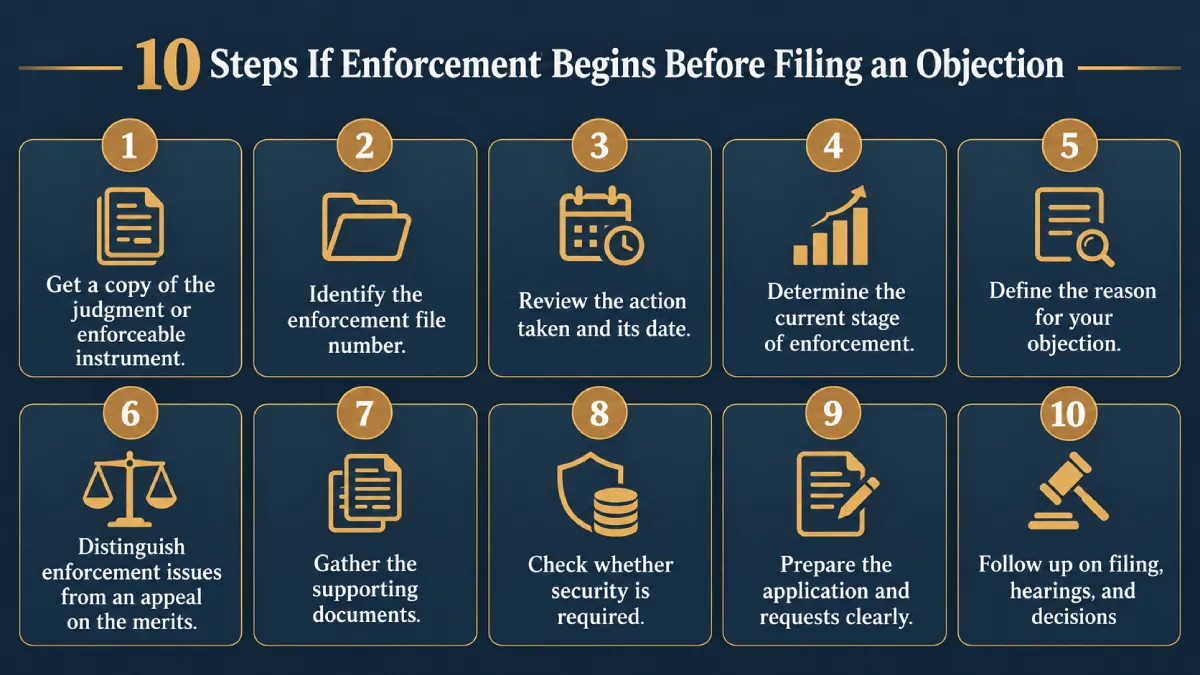
What Should You Do If Enforcement Has Already Begun Before Filing an Objection?
If you are unexpectedly faced with an enforcement measure, do not immediately begin drafting an objection. The first step is to understand what has happened and determine the stage the enforcement file has reached.
The practical steps may be arranged as follows:
- Obtain a copy of the judgment or enforceable instrument.
- Identify the enforcement file number.
- Review the enforcement measure already taken and its date.
- Determine the stage reached by the enforcement proceedings.
- Identify the grounds for objection precisely.
- Determine whether the objection concerns enforcement or the merits of the original judgment.
- Prepare the supporting documents.
- Determine whether security is required.
- Prepare the statement of claim and requests clearly.
- Follow up on registration, hearings, and any decisions issued.
The Kuwaiti Ministry of Justice also provides a Judicial Inquiry Service, which allows users to search for enforcement files and follow their details. This can help the concerned party obtain a clearer picture of the file before deciding on the next step.
The Role of a Lawyer in an Objection to Enforcement
The role of a lawyer in Kuwait begins with examining the grounds for the objection and comparing them with the enforcement measure that has been taken, then identifying the requests and documents required according to the status of the file. The lawyer also reviews the timing of the objection, the required documents, and the security where applicable, before preparing the requests and legal memorandum in a way that reflects the facts of the file and the procedures already taken.
This review becomes even more important where enforcement has already begun or multiple enforcement measures have followed one another, because incorrectly identifying the nature of the dispute or delaying action may affect the legal options available. Therefore, the mere existence of an objection to the judgment does not mean that an enforcement dispute procedure is the appropriate route in every case.
How Long Does an Objection to Enforcement Take in Kuwait?
The duration of an objection to enforcement is one of the most common concerns for anyone facing ongoing enforcement proceedings. However, it is important to distinguish between the deadline for filing the objection and the time the court may take to consider and decide it.
Article 211 does not specify a general filing deadline expressed as a fixed number of days. Instead, the timing depends on the stage of enforcement, provided that the objection is filed before enforcement is completed.
As for the time required to hear and decide the objection, there is no fixed number of days that applies to every case. The duration may vary depending on the nature of the case, service of notices, attendance, documents, and the procedures required for each file.
In practice, the priority remains to verify that enforcement has not yet been completed, as this issue must be addressed before estimating how long the court may take to consider the objection.
What Should a Defence Memorandum in an Enforcement Objection Include?
There is no single form that is suitable for every defence memorandum in an enforcement objection. The structure of the memorandum differs depending on the judgment, the enforceable instrument, the nature of the procedure, the grounds for the dispute, and the capacity of the parties.
Accordingly, the memorandum should focus on the enforcement dispute itself rather than repeating the entire original case.
It will usually include:
- The judgment or enforceable instrument subject to enforcement.
- The enforcement file number and the procedures taken within it.
- The legal capacity of the objecting party and their connection to the enforcement.
- The facts on which the grounds for the objection are based.
- The documents supporting those facts.
- The legal basis for the request.
- The effect of continued enforcement on the case, where relevant.
- The final relief requested from the court.
A defence memorandum in an enforcement objection is more coherent when each argument is connected to a clear fact, a specific document, and an appropriate legal provision, rather than relying on broad statements such as claiming that the enforcement is unfair or that the judgment was issued incorrectly.
Documents Required to File an Objection to Enforcement in Kuwait
There is no fixed list that applies to every objection, because the required documents vary depending on the nature of the judgment, the type of enforcement, and the grounds for the dispute.
Nevertheless, preparation of the file usually begins with the following basic documents:
- A copy of the judgment or enforceable instrument.
- Evidence of the enforcement measure being disputed.
- Details of the enforcement file.
- Documents supporting the grounds for the objection.
- A power of attorney where the application is submitted through a representative.
For certain procedures, such as objections before the Family Court, the Ministry of Justice specifies additional documents, including the objection petition, a copy of the judgment for which a stay of enforcement is requested, and an ID or power of attorney, in addition to documents that vary depending on the type of case. Therefore, the requirements applicable to one particular procedure should not be generalized to all enforcement disputes.
Fees and Security for an Objection to Enforcement in Kuwait
Last verified: October 2026 — Source: Kuwaiti Ministry of Justice.
The Ministry of Justice publishes official information concerning the fees and security applicable to an objection case seeking a stay of enforcement of a judgment.
| Item | Officially Published Amount |
|---|---|
| Case Stamp Fee | KWD 3 |
| Security for judgments other than tenancy judgments, according to the service page | KWD 30 |
| Security for tenancy judgments, according to the service page | KWD 100 |
It is advisable to verify the officially published information at the time of filing, as fees and administrative procedures may change.
Frequently Asked Questions About Enforcement Objections in Kuwait
Can someone other than the judgment debtor file an enforcement objection?
An enforcement objection may depend on whether the person filing it has a direct legal interest in the enforcement proceedings. The court will consider the person’s legal capacity, connection to the enforcement measure, and the grounds relied upon. The objection must concern the enforcement itself rather than merely express disagreement with the original judgment.
What happens if enforcement is completed before the objection is filed?
Timing is critical because Article 211 requires the objection to be filed before enforcement is completed. If enforcement has already been fully completed, the ordinary enforcement objection may no longer be the appropriate procedural route. The available legal option will then depend on the nature of the dispute and the measures already carried out.
Is a separate court application required to request a stay of enforcement?
A request to stay enforcement should be clearly stated within the appropriate enforcement dispute procedure. Whether the stay takes effect depends on the type of objection, how it is filed, and the applicable procedural rules. Filing an objection alone should not be assumed to suspend every enforcement measure automatically.
Can an enforcement objection be based on errors in the original judgment?
An enforcement objection is generally intended to address disputes arising from enforcement rather than reopen the merits of the original case. Arguments concerning whether the judgment itself was legally or factually wrong usually belong to the appropriate appeal or challenge procedure, subject to the circumstances and available legal remedies.
Does the court require security in every enforcement objection?
Security is not necessarily required in every enforcement dispute. Under Article 211, a KWD 30 security applies where the objection has the effect of staying enforcement, subject to statutory exceptions or exemptions. The applicable requirement should therefore be checked against the type of objection and the relief requested.
An objection to enforcement is not suitable for every challenge to enforcement, as its assessment depends on the nature of the dispute and the timing of the procedure. To determine the appropriate legal route, you can schedule an appointment with lawyer Fahad Ahmed Al-Saeed to review the enforcement file.
Disclaimer: This content is intended for general legal education only and does not constitute legal advice. Procedures and outcomes may vary depending on the facts of each case. It is recommended to consult official sources and seek advice from a qualified lawyer before taking any action.

A lawyer in Kuwait (Registration No. 3097) specializing in Court of Cassation cases, constitutional lawsuits, and litigation management. Through this personal platform, he provides precise and methodical legal explanations of litigation procedures and the principles of drafting legal memoranda. His aim is to provide readers with clear procedural knowledge to protect their rights and reduce the risks arising from procedural errors and missed legal deadlines