

If you receive an appeal from the opposing party while the judgment itself did not grant you everything you requested, it is not enough to think only about how to respond to the appeal. The first and more important step is to determine your own position toward the judgment: do you want it to remain as issued, or do you need to ask the court to amend part of it in your favor?
This is where the importance of cross-appeal and incidental appeal in Kuwait becomes clear. Defending a judgment is different from asking the court to change it. The problem does not always lie in the strength of the objection or the weakness of the argument; it may instead arise from choosing the wrong procedural route, directing the appeal against the wrong party, or taking action at the wrong time.
The matter becomes even more precise if your appeal deadline has expired, if you previously accepted the judgment, or if the dispute involves multiple parties. For this reason, reviewing the judgment and the original appeal with an appeal lawyer in Kuwait can help determine whether your position is limited to defending the judgment or requires a cross-appeal or an incidental appeal.
Have you received an appeal from the opposing party while you also object to part of the judgment? Lawyer Fahad Ahmad Al-Saeed can review the judgment and the appeal petition to determine whether your position is limited to defending the judgment or requires a cross-appeal or an incidental appeal, while also examining the applicable deadline and the procedural positions of the parties before any action is taken.
Request a Review of Your Appeal Position Now
Or continue reading first to understand the difference between a cross-appeal and an incidental appeal in Kuwait.
Cross-Appeal and Incidental Appeal in Kuwait: When Is a Defense Alone Not Enough?
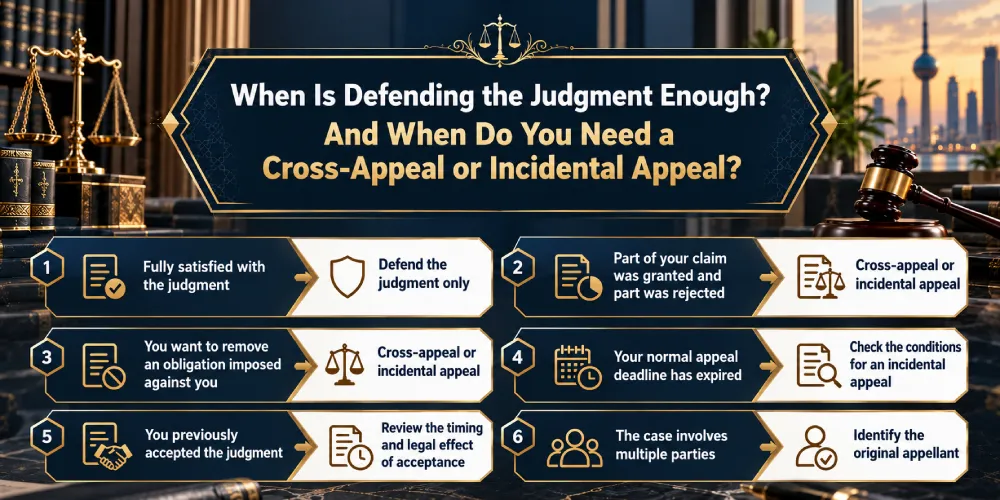
Your position depends on the result you want from the Court of Appeal. Procedurally, preserving the judgment is different from asking the court to amend part of it. The following table explains the main situations:
| Your Position Toward the Judgment | What Needs to Be Examined? |
|---|---|
| You are fully satisfied with the judgment | Defending the judgment |
| Part of your claim was granted and part was rejected | Cross-appeal or incidental appeal |
| You want to remove an obligation imposed against you | Cross-appeal or incidental appeal |
| Your appeal deadline has expired | Review the conditions for an incidental appeal |
| You previously accepted the judgment | Review the timing of acceptance and its legal effect |
| The case involves several parties | Identify the original appellant |
Article 144 of the Civil and Commercial Procedures Law provides that the case is transferred to the Court of Appeal only within the scope of the matters challenged by the appeal. Therefore, you should not assume that simply responding to the opposing party’s appeal will automatically cause the court to reconsider the part of the judgment that you want changed.
Cross-Appeal and When It Is Used in Kuwait
Article 143 of the Civil and Commercial Procedures Law allows the respondent to file a cross-appeal before the pleadings are closed.
It may be submitted through the ordinary procedures, by means of a memorandum setting out the grounds of appeal, or orally during the hearing in the presence of the parties, provided that it is recorded in the hearing minutes.
Understanding Cross-Appeal and Incidental Appeal in Kuwait becomes especially important when you are the respondent but also want the court to review part of the judgment in your favor.
This differs from filing an appeal case from the outset because you were not the party who initiated the appellate proceedings. Instead, you became the respondent after the opposing party filed the original appeal.
When Is an Appeal Considered Incidental in Kuwait?
An appeal is classified as an incidental appeal in two main situations regulated by law:
- If the respondent files it after their own appeal deadline has expired.
- If the respondent accepted the judgment before the opposing party filed the original appeal.
If either of these situations applies, the appeal is classified as an incidental appeal, together with the procedural consequences associated with that classification.
An important consequence of classifying the appeal as incidental is that it follows the original appeal and ceases to exist if the original appeal ceases to exist. A cross-appeal, however, does not automatically cease merely because the original appeal has ended.
Effect of Missing the Appeal Deadline in Kuwait
A respondent may believe that once the appeal deadline expires, the only remaining option is to defend the judgment, even if part of that judgment is unfavorable.
However, Article 143 regulates a special situation that allows the respondent, where an original appeal has been filed by the opposing party and the applicable conditions are satisfied, to submit an incidental appeal despite the expiry of the normal deadline.
This does not mean that the deadline for appealing a judgment starts again or is generally reopened. Rather, this possibility is specifically linked to the existence of the original appeal and to the respondent’s procedural status within it. For that reason, the incidental appeal remains dependent on the original appeal for its continuation.
Effect of Accepting the Judgment on an Incidental Appeal
If the respondent accepted the judgment before the original appeal was filed, the law regulates the possibility of submitting an incidental appeal in this situation.
However, the mere existence of acceptance is not enough to determine the legal position. Its timing is directly relevant.
Officially published judicial principles have also addressed cases in which the judgment was accepted after the original appeal had already been filed, explaining that this may affect the admissibility of an incidental appeal depending on the circumstances of the case.
Therefore, when reviewing the file, it is necessary to determine when the judgment was accepted in relation to the date of the original appeal, rather than simply knowing that the judgment was accepted at some stage.
Directing an Incidental Appeal When There Are Multiple Parties
In a published judicial principle, the Court of Cassation held that an incidental appeal is filed by the respondent and directed against the original appellant in their capacity as appellant.
Accordingly, a respondent cannot use this procedure against another respondent merely because that person is also a party to the same case.
This rule becomes particularly important when the case includes several claimants or defendants. Before taking any action, it is therefore necessary to determine:
- Who filed the original appeal.
- Who the respondents are.
- Which part of the judgment is sought to be changed.
- Which party the appeal is intended to be directed against.
- That party’s procedural capacity in the appeal proceedings.
An objection may be substantively valid, but directing the appeal against the wrong party can create a separate procedural problem.
Time Limit for Filing a Cross-Appeal or Incidental Appeal
The timing of Cross-Appeal and Incidental Appeal in Kuwait is governed by Article 143, which allows the relevant appeal to be submitted before the pleadings are closed. This is not a fixed period measured by a specific number of days because the progress of each case, the number of hearings, and the exchange of memoranda differ from one file to another.
Published judicial principles have also addressed situations in which a case was reserved for judgment while the parties were allowed to submit memoranda within a specified period, and the effect this may have on whether the pleadings remain open.
In practice, it is not advisable to leave the decision until the final stages. If you want the judgment amended, it is better to determine your position as soon as you receive the original appeal instead of creating an additional dispute over whether the appeal was filed in time.
Situations Requiring Caution Before Choosing an Incidental Appeal
Before relying on an incidental appeal as the appropriate route, your procedural position should be reviewed carefully. Certain situations may make this route unsuitable or affect its admissibility and continuation. The following table highlights the main points that require attention:
| Situation | What Requires Attention? |
|---|---|
| You only want the judgment to be upheld | You may not need to file an appeal at all |
| You want to direct the appeal against another respondent | The permissibility of directing an incidental appeal against that party must be reviewed |
| The pleadings have been closed | The time for submitting the appeal may have expired |
| The original appeal has ceased to exist | This affects the continuation of the incidental appeal |
Choosing the right procedure for Cross-Appeal and Incidental Appeal in Kuwait depends on your procedural position, the timing of the appeal, and its relationship with the original appeal.
Documents Required to Review Your Position in the Appeal
If you have already received the appeal, it is preferable to prepare the main documents before the review. These documents help a lawyer in Kuwait assess whether Cross-Appeal and Incidental Appeal in Kuwait procedures are relevant to your position or whether defending the original judgment is sufficient.
Among the requirements listed by the Kuwait Ministry of Justice for drafting incidental appeal petitions are several basic documents and details, including a copy of the judgment, a copy of the first-instance claim, and the details of the appellant and respondent. For a legal review, it is also preferable to prepare:
- The full judgment.
- The appeal petition filed by the opposing party.
- Your final requests before the Court of First Instance.
- The most important memorandum you submitted in the case.
- The document related to the part of the judgment you want changed.
- The date of the current hearing.
- A brief explanation of the part of the judgment with which you are dissatisfied.
These documents help review the timing of the appeal, the capacities of the parties, and the part of the judgment that is sought to be changed before the appropriate procedure is determined.
After the Appellate Judgment Is Issued
Once the appellate judgment is issued, the parties’ legal positions change depending on whether the court upheld, amended, or overturned the original judgment.
A different stage then begins, relating to the effects of the judgment and what becomes legally required after it is issued, including the enforcement of an appellate judgment according to its terms and the result reached by the court. For this reason, the operative part of the judgment and its legal effects should be read carefully before any further action is taken.
Frequently Asked Questions About Cross-Appeals and Incidental Appeals in Kuwait
Can a respondent ask the Court of Appeal to change part of the judgment?
Yes. If the respondent is dissatisfied with part of the judgment, merely defending against the original appeal may not be enough. Depending on the timing and procedural circumstances, the respondent may need a cross-appeal or an incidental appeal to ask the Court of Appeal to reconsider that specific part of the judgment.
Does an expired appeal deadline always prevent the respondent from challenging the judgment?
Not necessarily. Kuwaiti procedural law provides a specific situation in which a respondent may submit an incidental appeal after the ordinary appeal deadline has expired, provided an original appeal has already been filed and the relevant legal conditions are satisfied. This does not generally reopen the original appeal period.
What happens to an incidental appeal if the original appeal ends?
An incidental appeal is procedurally linked to the original appeal. Therefore, if the original appeal ceases to exist, the incidental appeal generally ceases with it. A cross-appeal is different because it does not automatically end merely because the original appeal has been withdrawn or otherwise ceased.
Can an incidental appeal be filed against another respondent in the same case?
Generally, the incidental appeal is directed by the respondent against the original appellant in their capacity within the appellate proceedings. The fact that another person is also a respondent in the same underlying case does not, by itself, make that person a proper target for an incidental appeal.
Properly dealing with a cross-appeal and incidental appeal in Kuwait requires reviewing the judgment, the original appeal, the timing of the procedures, and the procedural positions of the parties together, because a change in any one of these elements may alter the procedural classification of the appeal. If an appeal is currently pending, you can schedule an appointment with lawyer Fahad Ahmad Al-Saeed to review the file and determine the appropriate procedure.
Related Legal Articles:
- Defense Memorandum in Appealed Misdemeanor Cases in Kuwait: how to prepare it and a practical sample.
- Defense Memorandum in an Appeal for Increased Maintenance in Kuwait: key defenses and preparation steps.
- Action to Nullify an Appellate Judgment in Kuwait: when can nullity be considered and what are the procedures?
Disclaimer: This content is intended for general legal awareness only and does not constitute legal advice for any individual case. Reading it does not create a lawyer-client relationship. The appropriate procedural route varies according to the judgment, the procedural positions of the parties, the timing of the appeals, and the procedures taken in each case.
Official Sources:
- Kuwait Institute for Judicial and Legal Studies – 2023 Legal Updates: includes a Court of Cassation principle concerning incidental appeals, the situations in which they may be filed, the party against whom they may be directed, and the effect of having multiple respondents.
- Kuwait Ministry of Justice – Principles of Civil Procedure: includes a principle concerning acceptance of the judgment after the original appeal has been filed and its effect on the admissibility of an incidental appeal.

A lawyer in Kuwait (Registration No. 3097) specializing in Court of Cassation cases, constitutional lawsuits, and litigation management. Through this personal platform, he provides precise and methodical legal explanations of litigation procedures and the principles of drafting legal memoranda. His aim is to provide readers with clear procedural knowledge to protect their rights and reduce the risks arising from procedural errors and missed legal deadlines