
A procedural error may prevent the court from considering the grounds of an appeal, even when the objections to the judgment are serious. Therefore, the issue of inadmissibility of an appeal on procedural grounds in Kuwait first depends on whether the appellant has followed the correct legal route and complied with the required procedures before the court considers the merits of the dispute itself.
The need for review becomes greater when the appeal deadline is approaching or when the case has already gone through several procedures that may affect the procedural position of the parties. This is where an Appeals Lawyer in Kuwait can review the case file as a whole and identify the issues that should be examined before taking the next step.
Are you concerned that an error involving the deadline, legal standing, or procedures could prevent the court from considering the grounds of your appeal?
Lawyer Fahad Ahmed Al-Saeed can review the judgment, the sequence of proceedings, and the supporting documents to identify potential procedural risks and determine which legal step may be considered before any new action is taken.
Or continue reading to understand the grounds for inadmissibility and procedural defects
When Is an Appeal Inadmissible on Procedural Grounds in Kuwait?
The court first examines whether the chosen method of appeal is legally available and whether its procedural requirements have been satisfied. It then proceeds to consider the substantive grounds. Kuwaiti judicial principles establish that the court must determine whether an appeal is legally permissible before addressing its procedural validity. This means that the merits of the judgment are not examined until the preceding procedural requirements have been satisfied.
For this reason, Inadmissibility of an Appeal on Procedural Grounds in Kuwait may arise before the court reaches the substantive objections raised against the judgment, even when those objections appear legally significant.
Reasons for Inadmissibility of an Appeal on Procedural Grounds in Kuwait
Not all appeals are governed by identical rules. The applicable requirements depend on the type of appeal used and the nature of the decision being challenged. However, the general rules under the Kuwaiti Civil and Commercial Procedures Law help identify the main issues that should be reviewed before an appeal is filed.
Failure to Observe the Appeal Deadline
Deadlines are among the most sensitive aspects of appeal procedures. Under the Procedures Law, failure to comply with the prescribed appeal deadline results in the loss of the right to appeal, and the court may rule on this issue on its own initiative.
It is not sufficient to count the days from the date that the concerned party assumes to be the beginning of the deadline. Under Kuwaiti procedural rules, the general principle is that the appeal period begins on the date the judgment is issued, although certain cases provide for the period to begin from the date the judgment is formally served.
Before concluding that the appeal period has expired, the following should therefore be reviewed:
- The date on which the judgment was issued.
- Whether the party against whom the judgment was issued attended or was absent during the proceedings.
- Whether the beginning of the appeal period in the particular case depends on formal service of the judgment.
- Whether a legal circumstance affects the commencement, continuation, or suspension of the appeal period.
Lack of Legal Standing or Interest Required to Appeal
It is not enough for a person to believe that a judgment has harmed them for an appeal to be available. The person must have the required legal standing and an actual legal interest in changing the judgment or part of it.
The operative part of the judgment should therefore be reviewed to determine the legal position of the person seeking to appeal and whether the judgment was issued against them or otherwise affected their legal position in a way that justifies using the relevant appeal procedure.
The problem may sometimes arise from an inaccurate reading of the judgment. A party may believe that an appeal is necessary even though they have no legal interest in challenging part of the operative ruling, or their objection may concern an issue that does not affect their procedural position.
Using an Appeal Route That Is Not Available for the Judgment
Not every judgment is open to every form of appeal. It is therefore necessary to confirm that the selected appeal route is legally available for the judgment in question before drafting the grounds of appeal or preparing the supporting documents.
This issue is particularly relevant to judgments issued during ongoing proceedings. The Procedures Law restricts separate appeals against certain judgments issued before the final judgment that concludes the dispute, subject to exceptions established by law.
Reviewing the following questions can help determine the correct route from the outset:
| Question | What Should Be Verified? |
|---|---|
| Is the judgment appealable? | The nature of the judgment and the stage at which it was issued |
| Is the selected appeal route correct? | The form of appeal permitted by law for that judgment |
| Have its requirements been satisfied? | The deadline, legal standing, procedures, and required documents |
This review avoids spending time preparing grounds of appeal only to discover later that the appeal route used was not legally available in the first place.
A Material Defect in the Appeal Procedures
The law may impose a direct consequence where a statement or procedure required for the validity of an appeal has not been completed. The consequence varies depending on the nature of the violation and the provision governing it. It may result in nullity, inadmissibility, or another procedural sanction.
When assessing Inadmissibility of an Appeal on Procedural Grounds in Kuwait, it should not be assumed that every procedural error can be corrected after the appeal has been filed. The rule governing the procedure must first be reviewed to determine whether the law provides a specific consequence for non-compliance.
This review helps avoid a common situation in which the grounds of appeal are fully prepared, only for a procedural defect to be discovered that could have been identified before work began on the substantive arguments.
How Can You Avoid Procedural Defects in an Appeal?
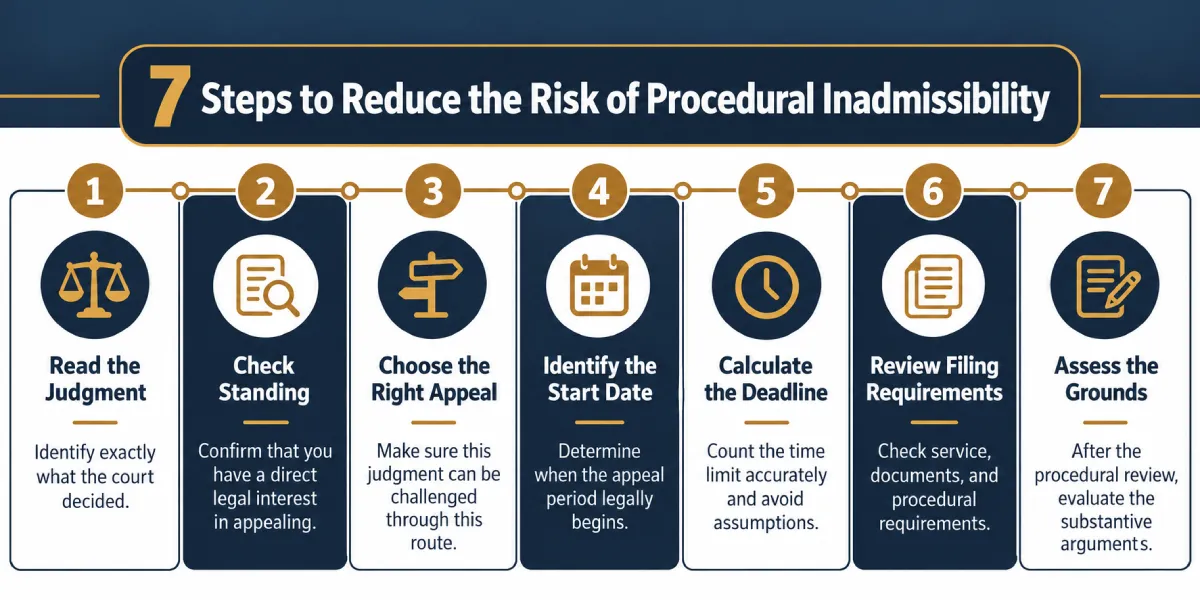
It is preferable to begin reviewing the case file from a procedural perspective before assessing the strength of the substantive grounds. Legally and logically, the availability of the appeal route and compliance with its requirements come before any discussion of whether the judgment itself is correct.
The initial review can be arranged as follows:
- Read the operative part of the judgment and identify precisely what the court decided.
- Verify the legal standing of the party seeking to appeal and their interest in changing the judgment.
- Identify the appeal route permitted by law for the judgment.
- Determine the date from which the appeal period legally begins.
- Calculate the deadline before preparing the appeal petition in its final form.
- Review the filing, service, and document requirements applicable to the selected appeal route.
- Only then proceed to assess the substantive grounds for challenging the judgment.
The Procedures Law also regulates circumstances that may affect the running of the appeal period, including the death of the party against whom the judgment was issued, loss of legal capacity to litigate, or termination of the representative capacity of the person who had been conducting the proceedings on that party’s behalf. Calculating the deadline may therefore require reviewing the specific facts of the case rather than simply counting calendar days.
What Is the Difference Between an Inadmissible Appeal and a Rejected Appeal?
The main difference concerns the stage reached by the court when considering the appeal:
| Outcome | What Does It Mean? |
|---|---|
| Appeal Found Inadmissible | The court stops at a procedural or formal issue, such as admissibility, legal availability of the appeal, or validity of the procedures, without examining the substantive grounds of appeal. |
| Appeal Rejected | The court has passed the procedural stage, examined the grounds of appeal, and concluded that they do not justify changing the challenged judgment. |
For this reason, understanding Inadmissibility of an Appeal on Procedural Grounds in Kuwait requires more than simply knowing that an appeal was rejected. The operative part of the decision and its reasoning should be reviewed to determine whether the issue concerned procedure, the merits of the case, or the legal unavailability of the appeal route used.
Can Another Legal Remedy Be Used?
The inadmissibility of an appeal on procedural grounds in Kuwait does not automatically make another legal remedy available. Some cases may require considering a Petition for Reconsideration, while different circumstances may raise the question of an Original Nullity Action.
In other files, the appropriate procedure may be an Appeal before the Court of Cassation, or the issue may concern an objection to a judgment issued in absentia. The correct approach depends on the type of judgment, the reason for inadmissibility, and the procedural stage reached by the case.
In cases involving Inadmissibility of an Appeal on Procedural Grounds in Kuwait, the reason for inadmissibility should be identified first, after which the legal remedy available for that particular situation can be assessed.
The Lawyer’s Role When There Is a Risk That an Appeal May Be Inadmissible
A lawyer can establish a clear timeline of the case by linking the claims, judgments, notices, and previous procedures. This makes it easier to identify inconsistencies or missing elements that may not be apparent when each document is reviewed separately.
Among the main steps an Lawyer in Kuwait may take at this stage are:
- Comparing the operative part of the judgment with the claims previously submitted to ensure that the appeal targets the part that gives the appellant an actual legal interest.
- Reviewing the sequence of procedures preceding the judgment and determining how they may have affected the party’s legal position.
- Comparing the findings stated in the judgment with the evidence contained in the documents so that the appeal is not based on a fact unsupported by the case file.
- Organizing the documents in a way that clearly shows important procedural facts, such as attendance, service of process, the sequence of judgments, and previous claims.
This review is particularly useful in cases that have passed through more than one level of litigation or involve multiple judgments, where arranging the facts and procedures chronologically becomes necessary to understand the source of procedural risk before taking the next step.
Frequently Asked Questions About Appeal Admissibility in Kuwait
Can strong legal arguments overcome a procedural defect in an appeal?
Yes. Strong substantive arguments do not cure a procedural defect that prevents the court from examining the merits. If the selected appeal route is unavailable, the deadline has expired, or a required procedural condition is missing, the court may stop at the admissibility stage without assessing whether the judgment itself was legally correct.
Does every filing error automatically make an appeal inadmissible?
Not necessarily. The legal effect depends on the requirement that was breached and the rule governing that procedure. Some defects may lead to nullity, inadmissibility, or another procedural consequence, while others may be capable of correction. The relevant provision should therefore be reviewed before assuming that a defect can or cannot be remedied.
Can a Kuwaiti court raise a procedural issue without a party requesting it?
In some procedural matters, yes. For example, the Kuwaiti Civil and Commercial Procedures Law provides that failure to observe the appeal deadline can result in loss of the right to appeal, and the court may address that issue on its own initiative. The exact position still depends on the applicable appeal procedure.
Which documents should be reviewed before an appeal is filed?
The review should include the judgment itself, especially its operative part, documents showing service or notification where relevant, records of attendance, previous procedural steps, and documents establishing the appellant’s legal standing and interest. The required file may differ depending on the type of appeal and the stage reached by the case.
Does service of the judgment always determine the appeal deadline?
No. The general rule may link the appeal period to the date the judgment is issued, while certain cases may make the starting date depend on formal service. Other events can also affect how the period runs. The correct starting point should therefore be determined from the applicable rule and the specific case record.
Assessing Inadmissibility of an Appeal on Procedural Grounds in Kuwait requires reviewing the decision or judgment together with the case file and the procedures that preceded it, because the legal effect varies according to the type of defect and the stage at which it was identified.
If the judgment has already been issued or the appeal period has begun, you can Schedule an Appointment with lawyer Fahad Ahmed Al-Saeed to review the documents and assess the procedural position before taking any new action.
Disclaimer: This content is intended for general legal awareness only and does not constitute legal advice. Reading it does not create a lawyer-client relationship. The legal assessment of each case depends on its particular facts, documents, and the procedures taken in relation to it.
Sources:
Official Judicial Principles of the Kuwait Institute for Judicial and Legal Studies, regarding the legal availability of appeals and the determination of procedural issues before examination of the merits.

A lawyer in Kuwait (Registration No. 3097) specializing in Court of Cassation cases, constitutional lawsuits, and litigation management. Through this personal platform, he provides precise and methodical legal explanations of litigation procedures and the principles of drafting legal memoranda. His aim is to provide readers with clear procedural knowledge to protect their rights and reduce the risks arising from procedural errors and missed legal deadlines