

You may discover a travel ban shortly before a business trip, a medical appointment, or an important personal commitment. In many cases, the real problem is that you do not know which file the ban was issued under or which procedure you should start with.
Therefore, lifting a travel ban in Kuwait begins with one essential step: identifying the restriction and understanding its cause. Only then can the appropriate route be determined, whether through payment, the creditor’s consent, an acceptable guarantee, or filing a grievance against the order.
There is no single solution that applies to every case. Each file has its own circumstances and documents, and the appropriate solution may differ depending on the status of the debt, the enforcement instrument, or the reason the restriction remains in force. For this reason, consulting an Enforcement Lawyer in Kuwait may be useful when the appropriate procedure is not clear from the file documents.
The end of a travel ban does not depend on one single method. What matters is the legal basis that keeps the order in force and whether the facts or documents have changed that basis in a way that allows the order to lapse or be cancelled.
Have you discovered a travel ban and are concerned that it may disrupt an upcoming trip? Lawyer Fahad Ahmed Al-Saeed can review the reason for the restriction and the enforcement file to determine the appropriate legal route, whether through payment, a guarantee, or a grievance, while helping you avoid steps that may not actually end the ban.
Request a Travel Ban Review Now
Or continue reading first to understand the grounds and procedures for lifting the ban before getting in touch
How Can You Check for a Travel Ban Before Having It Lifted in Kuwait?
Before considering how to lift the restriction, first confirm that a travel ban actually exists. Do not rely on unofficial information, and do not wait until you discover the issue when attempting to travel.
The Kuwaiti Ministry of Justice provides a travel ban inquiry service through its service centres. The person concerned or their representative may make the inquiry. The published information also indicates that the service does not require fees or additional documents, and the estimated completion time is approximately ten minutes.
The Ministry of Justice portal also provides an online personal inquiry service for travel ban orders, cases, and other procedures after identity verification through the Kuwait Mobile ID application.
If a restriction appears, record its details and the enforcement file number whenever available. At this point, the question changes from: “Do I have a travel ban?” to the more important question: “Why was the ban imposed, and what procedure may bring it to an end?”
Steps for Lifting a Travel Ban in Kuwait
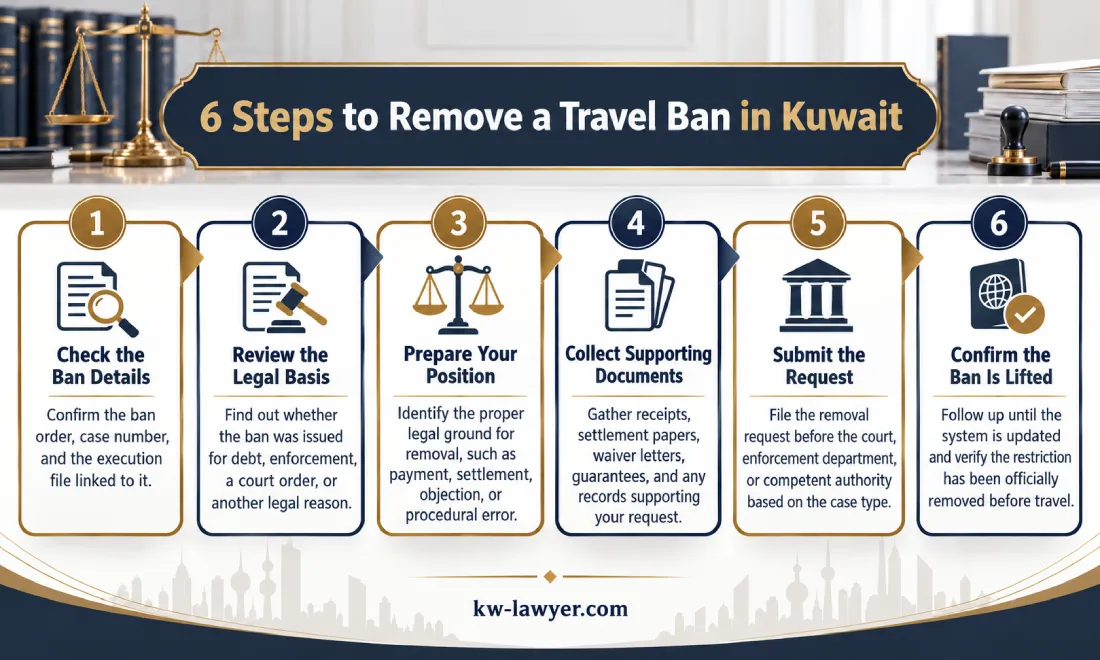
After identifying the reason for the restriction, Lifting a Travel Ban in Kuwait depends on the legal basis applicable to the file and the circumstances recorded in the enforcement case. The matter can be approached practically in the following order:
- Verify the details of the travel ban order and the related enforcement file number.
- Review the judgment or debt on which the restriction was based and determine its current status.
- Identify the legal ground on which you intend to request the lifting of the ban.
- Prepare the supporting documents, such as proof of payment, waiver, guarantee, or grounds for grievance.
- Complete the procedure before the Enforcement Department or the competent judicial authority, depending on the route being followed.
- Confirm that the restriction has been officially updated before making travel arrangements.
This sequence helps connect each step to the reason for the restriction and the documents required to complete the appropriate procedure.
When Is a Travel Ban Order Issued in Kuwait Enforcement Files?
A financial dispute alone is not sufficient to issue a civil travel ban. Article 297 of the Civil and Commercial Procedures Law sets out specific conditions, including that the creditor must have an established and due right and that there must be serious reasons to believe that the debtor may flee without satisfying the debt despite having the ability to pay.
The order is issued based on a petition submitted to the Enforcement Department. If the documents provided are insufficient, a brief investigation may be conducted before a decision is made on the application.
The travel ban order must also be served on the person against whom it was issued within two weeks from the date of issuance under Article 297. This period relates to service of the order and should not, by itself, be regarded as a general time limit for filing a grievance.
It is also important to distinguish between a travel ban connected with civil enforcement and a criminal travel ban, as each is governed by a different legal framework and procedure.
When Does a Travel Ban Order Lapse in Kuwait?
Article 298 identifies several situations in which a civil travel ban order may lapse. The correct approach is therefore not to try multiple procedures at random, but to first identify the legal situation that applies to the file.
| Situation | Legal Effect |
|---|---|
| Discharge of the obligation owed to the creditor | The basis for continuing the order comes to an end |
| One of the conditions for the ban ceases to exist | The order lapses |
| The creditor gives written consent | The order may be lifted |
| Providing a sufficient bank guarantee | May result in the order lapsing when the applicable requirements are satisfied |
| Providing a solvent guarantor accepted by the competent authority | May constitute a ground for lifting the order |
| Depositing the amount of the debt and its accessories with the Enforcement Department | The amount is allocated toward satisfying the creditor’s right |
| Failure to prove that the judicial claim was filed within the legally prescribed period | The order lapses where the relevant legal provision applies |
| Expiry of the prescribed periods without taking the enforcement measures referred to by law | May result in the order lapsing depending on the circumstances |
The article also provides that the order lapses if the creditor fails to submit evidence to the Enforcement Department that a judicial claim for the debt has been filed within seven days from the date the travel ban order was issued. It also regulates other situations involving the expiry of three years in specific enforcement circumstances.
However, these periods should not be applied generally to every file. It is first necessary to confirm that the legal situation described in the provision actually applies to the facts of the case.
Does Paying the Debt Lead to Lifting a Travel Ban in Kuwait?
If the travel ban was issued in connection with the enforcement of a judgment or an order for payment, payment may be one of the direct routes for Lifting a Travel Ban in Kuwait, provided the required enforcement procedure is completed.
The Ministry of Justice Travel Ban Office receives persons whose names are listed under travel bans and who wish to make payment. Once the amount has been collected in accordance with the approved procedures, a travel ban lifting letter is prepared and the restriction is removed from the system.
If the debt is discharged outside the Enforcement Department, however, different documentation is required. Article 298 provides for notifying the department of the discharge of the debt. The creditor must provide such notice within one week from the date the debt is discharged, and the debtor may also make the notification.
For this reason, merely keeping a bank transfer receipt or a private agreement between the parties may not be sufficient. The payment must also be legally and procedurally reflected in the enforcement file.
Can the Travel Ban Be Lifted Without Full Payment?
The order may lapse if the creditor gives written consent to its cancellation, if the debtor provides a sufficient bank guarantee, if a solvent guarantor accepted by the competent authority is provided, or if an amount equal to the debt and its accessories is deposited with the Enforcement Department in accordance with the applicable legal requirements.
The competent authorities also deal with procedures involving financial or personal guarantees, as well as lifting travel bans based on a judgment issued in a grievance or a waiver submitted by the creditor or the creditor’s representative.
The suitability of any of these routes depends on the status of the enforcement file and whether the proposed procedure satisfies its legal requirements.
When Is a Grievance Against a Travel Ban Order Appropriate?
A grievance becomes relevant when the issue is not simply a debt that the debtor wishes to pay, but rather a dispute concerning the validity of the travel ban order or whether the conditions for continuing it still exist.
Filing a grievance is one of the possible routes for lifting a travel ban in Kuwait when the objection concerns the legality of the order or the continued existence of its grounds, rather than simply the need to travel.
Article 297 provides that a travel ban order is subject to grievance in accordance with the provisions of the Civil and Commercial Procedures Law. Published judicial rulings also recognise that assessing the grounds for issuing the order and the grounds raised in a grievance falls within the authority of the competent judiciary.
Kuwaiti judicial principles have established that a grievance against a travel ban order may be considered before the Court of First Instance or the competent judge in accordance with the rules governing orders on petitions.
What Should Be Reviewed Before Filing a Grievance?
The fact that a travel ban has caused inconvenience or disrupted a trip is not, by itself, sufficient for a successful grievance. The application should be based on a legal or factual ground that affects the continuation of the order. It is important to review:
- Whether the conditions on which the travel ban was based still exist.
- The status of the debt and whether it has been discharged.
- The validity of the documents on which the order was based.
- Whether a guarantee exists or circumstances have changed in a way that affects the justification for continuing the ban.
- Any procedural or substantive ground supported by the documents in the file.
This review becomes particularly important where more than one claim or enforcement file exists, because cancelling one order does not necessarily mean that no other independent restriction remains in force.
What Is the Difference Between Lifting the Ban and Being Allowed to Travel While the Ban Remains in Force?
Article 297 allows the Director of the Enforcement Department to approve the debtor’s travel due to the debtor’s illness, or the illness of a first-degree ascendant or descendant, or the debtor’s spouse, provided that an official medical certificate establishes the need for treatment abroad and confirms that the treatment cannot be provided in Kuwait.
In this situation, the travel ban order remains in force. This differs from permanently lifting the ban:
- Lifting the ban: The restriction ends because one of the grounds for its lapse or cancellation applies.
- Permission to travel while the ban remains in force: An exception allowing travel in the circumstances regulated by law without terminating the order itself.
What Can Cause Delays in Lifting a Travel Ban?
A legal ground for lifting the ban may exist, yet the restriction may still remain in place. This often happens because the underlying issue was not identified correctly from the outset. Common situations include:
- Working on the wrong file: More than one enforcement procedure may exist, so the order number and the relevant file should be identified before payment or submission of an application.
- Paying outside the Enforcement Department without completing the required procedure: The restriction may remain in force if the discharge of the debt is not properly reflected in the enforcement file.
- Relying on an oral waiver: Written consent from the creditor is required where the waiver is being relied upon as the basis for lifting the order.
- Providing a guarantee that is not accepted by the competent authority: The fact that a guarantee is legally available does not mean that every guarantor or form of security will be sufficient.
- Similarity of names: A restriction may appear because of similar identifying information, which makes it necessary to review the person’s documents and confirm that the order actually relates to them.
When Do You Need an Enforcement Lawyer?
The assistance of a Lawyer in Kuwait who handles enforcement matters may be particularly useful when Lifting a Travel Ban in Kuwait requires reviewing the enforcement instrument, supporting documents, and previous procedures to determine the debtor’s legal position.
Legal review may be especially useful in situations such as:
- When it is unclear which procedure should be taken first.
- When there is a dispute concerning the reason the travel ban remains in force.
- When several procedures or claims involving the debtor overlap.
- When an action has taken place outside the enforcement file and its legal effect must be assessed.
- When filing a grievance is being considered and its suitability to the circumstances needs to be evaluated.
The lawyer’s role begins with analysing the enforcement instrument, the travel ban order, and any developments affecting the obligation, such as payment, guarantees, or objections recorded in the file. It can then be determined whether the matter requires proof that the debt has been discharged, written consent from the creditor, consideration of an available guarantee, or filing a grievance where the reasons for continuing the ban are disputed.
A lawyer cannot guarantee that the restriction will be lifted or that a legally prescribed judicial procedure will be shortened. However, reviewing the file at an early stage may help avoid submitting an application or document that does not address the actual reason the ban remains in force.
Frequently Asked Questions About Lifting a Travel Ban in Kuwait
Can more than one travel restriction exist at the same time?
A person may be subject to more than one independent enforcement file or travel restriction. Removing one order does not automatically cancel another. Before arranging travel, review the relevant file numbers and confirm the official status of every restriction recorded against you through the competent Kuwaiti authorities.
What if the debt was paid outside the Enforcement Department?
Payment made outside the Enforcement Department should be properly reflected in the enforcement file. Under Article 298, the department must be notified when the debt has been discharged. Keeping a transfer receipt or private agreement alone may not be enough unless the legal effect of payment is formally recorded.
Does cancelling one order guarantee that I can travel?
No. Cancelling one travel ban order does not necessarily mean that no other restriction remains. A separate enforcement file or independent order may still be active. It is therefore important to verify the official status of all relevant restrictions before relying on the cancellation of a single order.
Is a creditor’s verbal approval enough to remove the restriction?
Where the creditor’s consent is relied upon as the basis for lifting the travel ban, Article 298 requires written consent. A verbal agreement should not be treated as a substitute for the required documentation. The written approval must also be handled through the appropriate enforcement procedure for the restriction to be updated.
Lifting a travel ban in Kuwait ultimately depends on identifying the reason for the restriction accurately and then choosing the appropriate legal procedure to address it. The solution may involve proving that the obligation has been discharged, obtaining the creditor’s consent, providing a guarantee, making a deposit, or filing a grievance where the dispute concerns the order itself.
If you discover that a restriction is in place, do not start with the option that appears to be the fastest. Review the enforcement file and its documents first. If you need a legal review, you can schedule an appointment with Lawyer Fahad Ahmed Al-Saeed to review the documents and assess the appropriate procedural route for your circumstances.
Disclaimer: This content provides general legal information for educational purposes only. It does not constitute legal advice for any individual case, and reading it does not create a lawyer-client relationship. The appropriate course of action depends on the facts and documents of each case.

A lawyer in Kuwait (Registration No. 3097) specializing in Court of Cassation cases, constitutional lawsuits, and litigation management. Through this personal platform, he provides precise and methodical legal explanations of litigation procedures and the principles of drafting legal memoranda. His aim is to provide readers with clear procedural knowledge to protect their rights and reduce the risks arising from procedural errors and missed legal deadlines