

You can request the cancellation of administrative deportation in Kuwait by reviewing the grounds for the decision and submitting a reasoned request to the competent authority at the Ministry of Interior, supported by documents that justify reconsideration. The usefulness of this procedure depends on the nature of the decision and the facts supporting the request.
This is where consulting an administrative lawyer in Kuwait becomes important. A lawyer can examine the decision and explain the available legal options, whether the person is still in Kuwait and faces deportation or has already left the country and wishes to return.
The possibility of cancelling administrative deportation in Kuwait depends on the grounds for the decision, its stage of enforcement, and the documents supporting a request for reconsideration. An order that has not yet been enforced must be approached differently from a case involving someone who has already been deported and wishes to return. Under the Foreigners’ Residence Law, returning to Kuwait after deportation requires permission from the Minister of Interior.
Have you received an administrative deportation order and are worried about being separated from your family or having your affairs in Kuwait disrupted? Contact a licensed lawyer to discuss your legal position and find out whether your circumstances may justify requesting reconsideration of the decision or exploring the possibility of returning after deportation.
Or continue reading to learn about the available legal procedures.
When Can You Request Cancellation of Administrative Deportation in Kuwait?
A request for reconsideration becomes relevant when there are facts or documents that could affect the assessment of the grounds on which an administrative deportation order was issued. The purpose is to explain those facts and establish their connection to the decision, rather than simply ask for its cancellation.
Reviewing the order becomes particularly important when documents or circumstances warrant a fresh assessment of the case. These may include:
- Errors in the facts: For example, where the decision relies on information that conflicts with official documents.
- Newly available documents: Where the documents relate to the reasons for deportation and were not available when the order was issued.
- Changes in relevant circumstances: Where significant new facts may affect the review of the request.
- Family or humanitarian circumstances: Such as family members depending on the person subject to deportation, provided these circumstances are supported by appropriate documents.
To prepare a clear request, connect each document to the fact it establishes. Avoid relying solely on a general appeal for leniency that does not explain why the decision should be reconsidered.
When Can an Administrative Deportation Order Be Issued in Kuwait?
Article (20) of Decree-Law No. 114 of 2024 concerning the Residence of Foreigners authorizes the Minister of Interior to order the deportation of a foreign national within a specified period, even if that person holds a valid residence permit.
The law identifies the circumstances in which such an order may be issued:
- No lawful source of income: Where the foreign national has no lawful means of earning a living.
- Violation of Article (19): Including certain cases in which a foreign national works for someone other than the authorized employer or is employed without the required permission.
- Public interest considerations: Where the Minister of Interior considers deportation necessary in the interests of the public, public security, or public morals.
How Does an Administrative Deportation Order Affect Detention and Enforcement?
Submitting an appeal for leniency or a request for reconsideration does not automatically suspend enforcement of a deportation order. Enforcement procedures may continue unless the competent authority makes a decision that changes the legal position.
Article (22) of the Foreigners’ Residence Law also permits the detention of a foreign national subject to a deportation order for a period not exceeding 30 days, with the possibility of renewal under the conditions set out in that Article, if detention is necessary to enforce the order.
It is important to distinguish the period of detention for enforcement purposes from the time it may take to review a request for cancellation. These are separate matters, and the stated detention period is not a statutory deadline for deciding a cancellation request.
If the person has been detained or departure procedures have begun, check the relevant enforcement decisions and notices, including their dates, to establish what actions have actually been taken in the case.
Steps to Request Cancellation of Administrative Deportation in Kuwait
An official report submitted by Kuwait to the United Nations states in paragraph (74) that a person detained pending deportation may submit a petition for reconsideration to the administrative authority, which can examine and decide on the request. The report dates from 2020, before the current Foreigners’ Residence Law was issued, and does not set out a standardized government procedure for submitting such requests.
To prepare a request for cancellation of administrative deportation in Kuwait, consider the following practical steps:
- Identify the type of decision: Determine whether the measure is administrative deportation, removal from the country, or judicial deportation, as the applicable rules and procedures differ.
- Review the grounds for deportation: Examine the decision and the documents relating to the case to identify grounds that may support a request for reconsideration.
- Collect supporting documents: Gather documents that establish relevant facts, such as residence, employment, or family records, depending on the circumstances.
- Prepare a reasoned request: Set out the applicant’s details, identify the decision to be reconsidered, and explain the supporting facts, grounds, and documents.
- Confirm where to submit the request: Ask the Ministry of Interior which department handles such applications, how they should be submitted, and what requirements apply at the time.
- Follow up on the request: Keep proof of submission, review official responses, and provide any additional documents or explanations requested by the competent authority.
To confirm the responsible authority and the submission procedure, consult the Ministry of Interior’s General Department of Residency Affairs and review its available official instructions and contact channels.
These are practical steps for preparing and following up on a case. They do not constitute a single standardized government process or an official mandatory checklist for every administrative deportation cancellation request.
Documents Needed to Request Cancellation of Administrative Deportation
The following table outlines documents that may support a request for cancellation of administrative deportation in Kuwait and explains how each can help establish the relevant facts of the case:
| Document | Purpose |
|---|---|
| Copy of the deportation order or available notice | Identify the grounds for the decision and its date |
| Passport and previous Civil ID | Confirm the applicant’s identity and personal details |
| Residence and employment documents | Clarify the person’s previous legal status |
| Court judgments and official records relevant to the case | Review the facts that may have led to deportation |
| Marriage and birth certificates, where applicable | Establish family relationships and circumstances |
| Previous applications and official responses | Establish the steps already taken and their outcomes |
This list does not mean that every document is required in every case, nor is it an official exhaustive list of Ministry of Interior requirements. Additional documents may be necessary depending on the nature of the decision and what the competent authority requests.
If deportation is connected to an employment violation or a dispute with an employer, it may also be necessary to examine immigration and residency issues in Kuwait separately to understand the relationship between the residence violation and the reasons for deportation.
Does a Deportation Order Include the Spouse and Children?
An administrative deportation order may affect family members in certain circumstances. Article (21) of the Foreigners’ Residence Law permits the order to include non-Kuwaiti family members whom the foreign national is legally responsible for supporting.
However, deporting one family member does not automatically mean that the spouse and children will also be deported. This depends on the scope of the order and the competent authority’s decision under the law.
It may also be necessary to review the residence status of the spouse and children separately to determine whether the deportation order includes them or applies only to the person concerned.
In these circumstances, prepare documents establishing family relationships and financial dependency, and check each person’s legal status and whether they are covered by the order.
Can You Obtain Time to Settle Your Affairs Before Deportation?
A person subject to deportation may have financial obligations, property, or other interests that need to be settled before leaving Kuwait. Article (25) of the Foreigners’ Residence Law addresses this situation and allows a foreign national ordered to be deported or removed to be granted time to settle their affairs, subject to the rules set by the Minister of Interior.
However, such a period is not granted automatically simply because these interests exist. The person concerned cannot determine its duration independently or assume they may remain in Kuwait without approval from the competent authority.
If the deportation is connected with unpaid employment entitlements, those rights may need to be considered separately with a labour lawyer in Kuwait, distinguishing claims for outstanding entitlements from procedures concerning the deportation order.
Can an Administrative Deportation Order Be Challenged in Court?
Item Five of Article One of Decree-Law No. 20 of 1981, concerning the establishment of a division of the Court of First Instance to hear administrative disputes, as amended by Law No. 61 of 1982, excludes decisions relating to the residence and deportation of non-Kuwaitis from the division’s jurisdiction to hear applications to annul final administrative decisions.
Accordingly, requests to annul administrative deportation orders generally fall outside the jurisdiction established under this provision. A refusal of an appeal for leniency does not, by itself, alter that exclusion.
If other, separate decisions have been issued in connection with the matter, the nature and legal basis of each decision should be identified before considering whether it can be challenged before the competent court. This helps avoid pursuing procedures that do not fit the type of dispute involved.
Can You Return to Kuwait After Administrative Deportation?
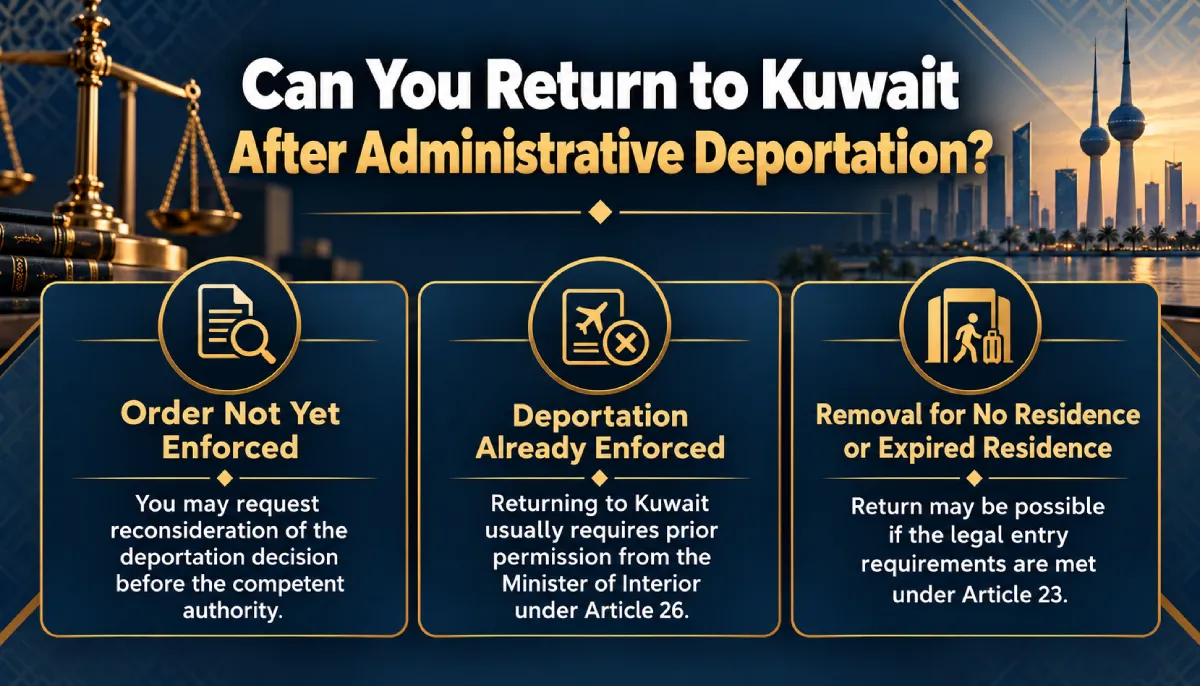
Under Article (26) of the Foreigners’ Residence Law, a foreign national who has already been deported must obtain permission from the Minister of Interior before returning to Kuwait.
Administrative deportation must be distinguished from removal from Kuwait. Article (23) addresses the removal of a foreign national who does not hold a residence permit or whose permit has expired. In such cases, the person may return upon meeting the legal entry requirements.
The following table highlights the differences between these situations and the procedures to consider:
| Situation | Procedure to Consider |
|---|---|
| A deportation order has been issued but not enforced | Request reconsideration from the competent authority |
| Deportation has been enforced and the person has left Kuwait | Consider applying for permission to return under Article (26) |
| Removal because a residence permit was missing or had expired | Confirm compliance with the entry requirements under Article (23) |
Before arranging travel to Kuwait or accepting a new job offer, confirm that the required permission to return has been granted and that current entry conditions have been met. This helps avoid making plans that do not legally allow the person to re-enter the country.
The Role of a licensed lawyer in Reviewing a Deportation Order
When contacting a licensed lawyer about an administrative deportation order, explain when it was issued, whether it has already been enforced, and whether there have been any official responses to previous requests. This information helps identify the legal issues that require review, rather than starting procedures that may not be appropriate for the case.
A legal review can help determine whether additional documents are needed, which procedure may be worth considering, and what legal restrictions apply. It also allows the person concerned to understand their position before deciding on the next step, without implying any guarantee that the deportation order will be cancelled or that permission to return will be granted.
Frequently Asked Questions About Cancellation of Administrative Deportation in Kuwait
Will a request for leniency allow me to remain in Kuwait?
Submitting a request for leniency or reconsideration does not automatically suspend an administrative deportation order. The competent authority may continue enforcement while the request is being examined. You should check the current status of the order, any enforcement notices, and whether an official decision has changed your legal position.
Does a valid residence permit protect someone from deportation?
Not necessarily. Article 20 of Kuwait's Foreigners' Residence Law allows administrative deportation in specified circumstances even when a foreign national holds a valid residence permit. The grounds for the decision must therefore be examined separately from the permit's validity. A valid permit alone does not establish that the order is invalid.
What if official records show the deportation grounds are incorrect?
Documents that contradict the facts relied upon in a deportation order may be relevant to a request for reconsideration. Identify the specific error, explain its connection to the decision, and include the official records supporting your position. Such evidence can support a review, but it does not guarantee cancellation.
Will family dependency automatically reverse the decision?
No. Marriage, children, and financial dependency may be relevant circumstances, but they do not automatically cancel an administrative deportation order. Family documents should establish the relationship and the circumstances relied upon. The competent authority must still assess the request and determine whether those facts justify reconsidering the decision.
The practical first step when seeking cancellation of administrative deportation in Kuwait is to prepare a copy of the order and any previous official responses. These can then be reviewed with a lawyer in Kuwait to assess the legal position based on clear facts and supporting documents.
You can also schedule an appointment with a licensed lawyer to present your case and discuss the legal course most appropriate to your circumstances, whether you are facing a deportation order that has not yet been enforced or want to explore the possibility of returning to Kuwait after deportation.

Kuwait Lawyer is a legal information and guidance platform in Kuwait. It publishes plain-language articles and guides to legal procedures and relevant authorities.