
You may obtain a final court judgment ordering the other party to pay what you are owed, only to find that they refuse to comply despite your efforts to pursue enforcement. Matters can become even more complicated if the debtor claims to have no assets or starts disposing of property to avoid payment.
Yet failure to enforce a final court judgment in Kuwait does not mean that you have lost your rights. The Civil and Commercial Procedures Law provides measures for identifying the debtor’s assets and addressing refusal to comply, including applying for the debtor’s detention when the legal conditions are met.
Failure to enforce a final court judgment means that the judgment debtor has not fulfilled an obligation imposed by a judgment, even though the requirements for enforcement have been satisfied. Not every delay in payment amounts to deliberate evasion. The debtor’s financial capacity and the reasons for non-compliance must first be examined to determine the appropriate measure under Kuwait’s Civil and Commercial Procedures Law.
Have you obtained a final court judgment in your favor but still not received the money owed to you, despite following up on enforcement? Lawyer Fahad Ahmed Al-Saeed can review your enforcement file, identify the reasons for the delay, and assess the legal measures available when a debtor refuses to pay, helping you understand the next step for your case.
Request an Enforcement File Review
Or keep reading to learn about the available legal measures.
How to Address Failure to Enforce a Final Court Judgment
Start by reviewing the enforcement file to understand why the process has stalled. The judgment may be final and properly served, yet the debtor may still refuse to comply. In that case, identify the appropriate legal measure rather than repeatedly submitting requests that do not address the cause of the delay. If the judgment was issued by a foreign court, first review the requirements for enforcing a foreign judgment in Kuwait.
Reviewing the file with a judgment enforcement lawyer in Kuwait can help assess three key issues:
- Status of the enforcement file: Have the judgment and its service met the requirements for the proposed measure?
- The debtor’s financial capacity: Is there information or documentation indicating that the debtor owns assets that could justify a request to disclose their property?
- Reason for non-compliance: Is the debtor genuinely unable to pay, or is there evidence that they can pay but refuse to do so?
The outcome of this review will clarify the problem and whether additional documents or a new application to the competent authority are required.
Why Does a Judgment Debtor Refuse to Comply with a Court Judgment in Kuwait?
There are several reasons why a judgment may remain unpaid, and the appropriate response depends on the circumstances. The following table outlines common situations and what should be examined before taking action:
| Situation | What Should Be Examined? |
|---|---|
| The debtor refuses to pay despite a demand for payment | Evidence of refusal and the debtor’s ability to pay |
| The debtor claims to have no assets | The debtor’s financial position and the results of asset inquiries |
| The debtor transfers assets to another person | The timing and value of the transfer and whether the conditions for legal intervention are met |
| The debtor pays part of the judgment debt | The outstanding balance and documents confirming the payment |
| A court order affecting enforcement is issued | The nature of the order and its effect on the continuation of enforcement proceedings |
When dealing with failure to enforce a final court judgment, it is important to distinguish genuine inability to pay from deliberate refusal. This distinction affects which measures may lawfully be taken against the debtor.
What Legal Measures Are Available When a Debtor Refuses to Comply with a Judgment in Kuwait?
Decree-Law No. 59 of 2025 regulates a number of measures relating to a debtor’s refusal to pay and introduced Article 204 bis into Kuwait’s Civil and Commercial Procedures Law.
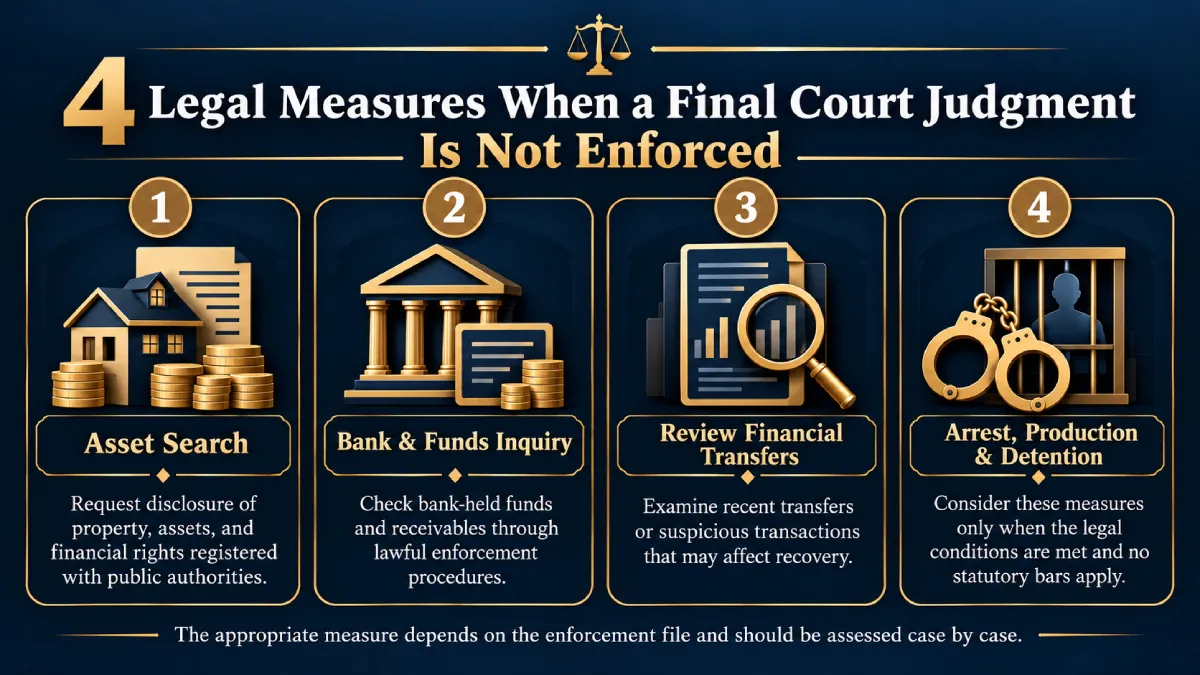
In cases of failure to enforce a final court judgment, the following measures may be considered after the necessary enforcement steps have been taken:
- Disclosure of immovable and movable assets: Requesting information about the debtor’s property and financial rights from the relevant government authorities.
- Disclosure of funds held by banks and third parties: Identifying bank balances and present or future financial entitlements in accordance with legal requirements.
- Review of previous financial transactions: Requesting information about certain transactions involving the debtor’s assets during periods specified by law.
- Application for arrest, production before the competent authority, and detention: Considering these measures when the conditions of Article 292 are met and no legal bar applies.
A judgment does not give the creditor an automatic right to access all of the judgment debtor’s financial information. Disclosure procedures must follow the law and be carried out through the Director of the Enforcement Department or the judges assisting the Director, within their respective powers.
The scope of each request depends on the information available about the debtor and the action the creditor intends to take. Once assets have been identified, the creditor may proceed to attach them. For more details, see the article on the enforcement attachment report.
When Can a Debtor Be Detained for Failing to Comply with a Final Judgment?
Kuwaiti law allows an application for the debtor’s arrest, production before the competent authority, and detention if the debtor refuses to comply with a final judgment despite evidence of an ability to pay, subject to the conditions set out in Article 292 of the Civil and Commercial Procedures Law.
The creditor files the application by petition, while the Director of the Enforcement Department or an assisting judge has authority to issue the order. The law limits detention to a maximum of six months, with the manner of its implementation specified in the order.
In addition to requiring proof of ability to pay, the law sets out circumstances that prevent a detention order from being issued, even when the debt remains outstanding.
What Prevents a Detention Order from Being Issued Against a Debtor?
Article 294 of the Civil and Commercial Procedures Law identifies circumstances in which a detention order may not be issued, including:
- The debtor is 21 years old or younger, or over 65 years old.
- The debtor provides a sufficient bank guarantee or another form of security accepted by law.
- A medical report establishes that the debtor has an illness that makes detention unsuitable, or the debtor is pregnant.
- The debtor’s available assets consist solely of property that cannot legally be attached.
- The maximum permitted detention period has already been served in relation to the same debt, under the applicable rules.
Other legal restrictions relate to family relationships and certain family circumstances, including situations involving minor children. All the conditions of the article should therefore be reviewed before submitting an application.
Article 293 also allows the debtor to be granted a period of up to one month to pay and permits payment by installments with the creditor’s consent, provided the legal requirements are satisfied. Enforcement may also involve a travel ban. The article on lifting a travel ban in Kuwait explains when such an order ceases to apply and how it may be lifted.
How Do You Apply for a Debtor’s Detention in Kuwait?
The Kuwaiti Ministry of Justice offers an official service for submitting an application for a debtor’s detention or production before the competent authority, as well as renewing an application for production, through the Enforcement Departments in the governorates.
The basic steps are as follows:
- Confirm that the judgment is final, and prepare the enforceable instrument and proof of service.
- Prepare the detention application and attach supporting documents, particularly evidence of the debtor’s ability to pay.
- Submit the application to the competent Enforcement Department, either in person or through an authorized representative, in accordance with the applicable procedures.
- Follow up on the application and check whether the competent authority has requested further documents or considers a brief inquiry necessary.
An order may not be issued if there is insufficient evidence of the debtor’s ability to pay or the required documents have not been provided. It is therefore advisable to address these gaps before applying.
What Are the Fees and Processing Time for a Debtor Detention Application in Kuwait?
The Kuwaiti Ministry of Justice publishes the fees and approximate time required to complete the administrative process for an application for a debtor’s detention and production.
Last checked: October 25, 2026 — Source: Kuwaiti Ministry of Justice.
| Item | Official Information |
|---|---|
| Competent authority | Enforcement Departments in Kuwait’s governorates |
| Type of transaction | Application for debtor detention |
| Detention application fee | KWD 1 |
| Application for production and its renewal | No fee, according to the service page |
| Listed administrative document | Applicant’s civil ID |
| Approximate administrative processing time | 15 minutes |
The information in the table concerns the administrative transaction. It does not remove the need to satisfy the legal conditions for deciding a detention application.
Important: The 15-minute period refers to completion of the administrative transaction, as stated by the Ministry. It does not mean that a detention order will be issued within that time or that the creditor will recover the money during that period.
What If the Debtor Conceals Assets to Avoid Enforcement of the Judgment?
In some cases, failure to enforce a final court judgment may be linked to the debtor’s disposal or transfer of assets. Such transactions require careful examination of their timing, value, and purpose.
However, selling an asset or transferring its ownership does not, by itself, make the transaction unlawful. The timing, nature, and value of the transaction must be examined, along with whether the legal conditions for intervention are satisfied.
Article 204 bis (A) addresses certain situations in which the debtor disposes of assets without payment or for a price substantially below market value after the debt has arisen.
It permits the creditor to apply for an order suspending dealings in the asset if the prescribed conditions are met and the asset remains in the possession of the person who received it from the debtor.
Deadline for Filing an Action to Declare a Transfer Ineffective Against the Creditor
If an order suspending dealings in an asset is issued under Article 204 bis (A), the creditor must file an action seeking to have the transfer declared ineffective against them within one week, starting on the day after the order is issued. The action must name both the debtor and the person to whom the asset was transferred.
If the action is not filed within that period, the suspension order is treated as if it had never been issued, as provided by law.
This does not invalidate the original court judgment or extinguish the debt. Only the suspension order loses its legal effect.
Is Concealing Assets a Crime in Kuwait?
A debtor may face criminal liability if it is established that they concealed, moved, or transferred assets with the intention of evading payment of a debt established by an enforceable instrument, and the elements required by law are satisfied.
Decree-Law No. 65 of 2025 introduced provisions into the Kuwaiti Penal Code concerning debtors who evade payment, including Articles 283 and 285.
Nevertheless, late payment must be distinguished from conduct that constitutes a criminal offense. Not every debtor who fails to comply with a judgment has committed a crime, even if the debt remains unpaid for a long time.
Documents Needed to Establish a Debtor’s Refusal to Comply with Enforcement
When assessing failure to enforce a final court judgment, the following documents can help establish the cause of the delay and identify an appropriate course of action:
- A copy of the final judgment, the enforceable instrument, and proof of service.
- The enforcement file number and copies of previous orders and applications.
- Documents proving any payments already made by the debtor, if part of the debt has been paid.
- Any available documents indicating the existence of assets or relevant financial transactions.
- Correspondence and notices relating to demands for payment or the debtor’s refusal to pay.
The creditor is not required to know about every asset owned by the judgment debtor, as the law provides ways to request disclosure through the competent authorities.
Anyone seeking an overview of how to obtain an enforceable instrument, open an enforcement file, and begin attachment proceedings can consult the guide to enforcement of judgments in Kuwait, which explains those stages separately.
A review of the file may reveal that the delay is connected to a judicial dispute affecting an enforcement measure. In that situation, the rules governing objections to enforcement should be considered according to the nature of the dispute, without confusing such objections with a debtor’s refusal to comply with the judgment.
When Do You Need a Lawyer If Enforcement of a Judgment Has Stalled?
Seeking help from a lawyer in Kuwait becomes important when enforcement stops despite all requirements having been met, new evidence emerges about the debtor’s assets, or an order is issued whose effect on the enforcement file needs to be assessed.
Lawyer Fahad Ahmed Al-Saeed can review the judgment and previous proceedings and assess whether the legal requirements for available applications are met, helping the creditor gain a clearer understanding of the case.
The legal review may include:
- Reviewing decisions issued on previous enforcement applications.
- Identifying missing documents or information that can be supplied.
- Assessing whether a further legal measure is appropriate given the debtor’s circumstances.
- Checking legal deadlines that could affect the continuation of proceedings.
- Explaining the available legal route and the steps required to pursue it.
A legal review does not guarantee recovery of the debt or the issuance of any particular order. The outcome depends on the facts, the available evidence, and the decision of the competent authority.
Frequently Asked Questions About Failure to Enforce a Final Court Judgment
Does paying part of the awarded amount close an enforcement file?
No. A partial payment does not, by itself, establish that the entire judgment debt has been discharged. The creditor should keep proof of every payment, calculate the outstanding balance, and review the enforcement file for any order or agreement affecting the remaining amount before requesting further action.
Must the creditor provide bank account numbers to trace funds?
Not necessarily. Kuwaiti enforcement procedures provide mechanisms for seeking information about a judgment debtor’s assets and financial rights through competent authorities. The creditor should provide any available identifying details and relevant documents. Disclosure is subject to legal requirements and does not grant unrestricted access to private banking information.
Can enforcement measures target money the debtor receives later?
Potentially, depending on the type of entitlement and the applicable enforcement rules. The legal measures discussed under Decree-Law No. 59 of 2025 include inquiries into present and future financial rights held by banks or third parties. Any subsequent attachment must follow the procedures and restrictions established by law.
What if an enforcement application is returned for missing evidence?
If supporting documents are incomplete, the competent authority may ask for additional information or decline to issue the requested order. Check what is missing, particularly evidence relevant to the debtor’s ability to pay if detention is requested, and submit the required material through the proper enforcement procedure.
The appropriate response to failure to enforce a final court judgment in Kuwait depends on why enforcement has stalled and what the documents reveal about the debtor’s financial position. The case may require an asset disclosure request, consideration of the conditions for detention, or an examination of transactions undertaken to avoid payment.
If a final judgment has been issued in your favor but the judgment debtor has not complied, you can schedule an appointment with lawyer Fahad Ahmed Al-Saeed to review the enforcement file and assess the legal measures appropriate to your circumstances.
Legal disclaimer: This article provides general legal information about Kuwaiti legislation for educational purposes only. It does not constitute legal advice tailored to a particular case or guarantee any outcome, and reading it does not establish a lawyer-client relationship. The appropriate course of action depends on the judgment, the supporting documents, and the circumstances of each case.

A lawyer in Kuwait (Registration No. 3097) specializing in Court of Cassation cases, constitutional lawsuits, and litigation management. Through this personal platform, he provides precise and methodical legal explanations of litigation procedures and the principles of drafting legal memoranda. His aim is to provide readers with clear procedural knowledge to protect their rights and reduce the risks arising from procedural errors and missed legal deadlines