You may unexpectedly receive an Enforcement Attachment Report concerning your assets in Kuwait, or a notice stating that your bank balance or a sum owed to you has been attached. In such circumstances, you may naturally question whether the attachment is valid, which assets it covers, and whether any legal deadlines apply.
To understand your legal position, first review the report, identify the type of attachment and the legal instrument on which it is based, and then examine its details and related notices under the Kuwaiti Civil and Commercial Procedures Law.
Have you received an Enforcement Attachment Report but are unsure whether its details are correct or which assets it covers? Lawyer Fahad Ahmed Al-Saeed can review the report and supporting documents to clarify your legal position and the appropriate next step.
Or continue reading to learn about the report’s required details and legal deadlines.
What Is an Enforcement Attachment Report in Kuwait?
An Enforcement Attachment Report is an official document recording an attachment carried out against a debtor’s assets under Kuwaiti law. Its required details and legal effects vary depending on the type and location of the attached assets, whether movable property in the debtor’s possession or funds and rights held by another party, such as a bank.
The issuance of an Enforcement Attachment Report does not mean the creditor has recovered the amount owed. It records the attachment measure, while actual recovery remains subject to completion of the subsequent procedures required by law.
Discrepancies in the report’s details or the scope of attachment may warrant assistance from a lawyer specializing in the enforcement of judgments in Kuwait to review the documents relating to the procedure.
What Should You Do Immediately After Receiving an Enforcement Attachment Report in Kuwait?
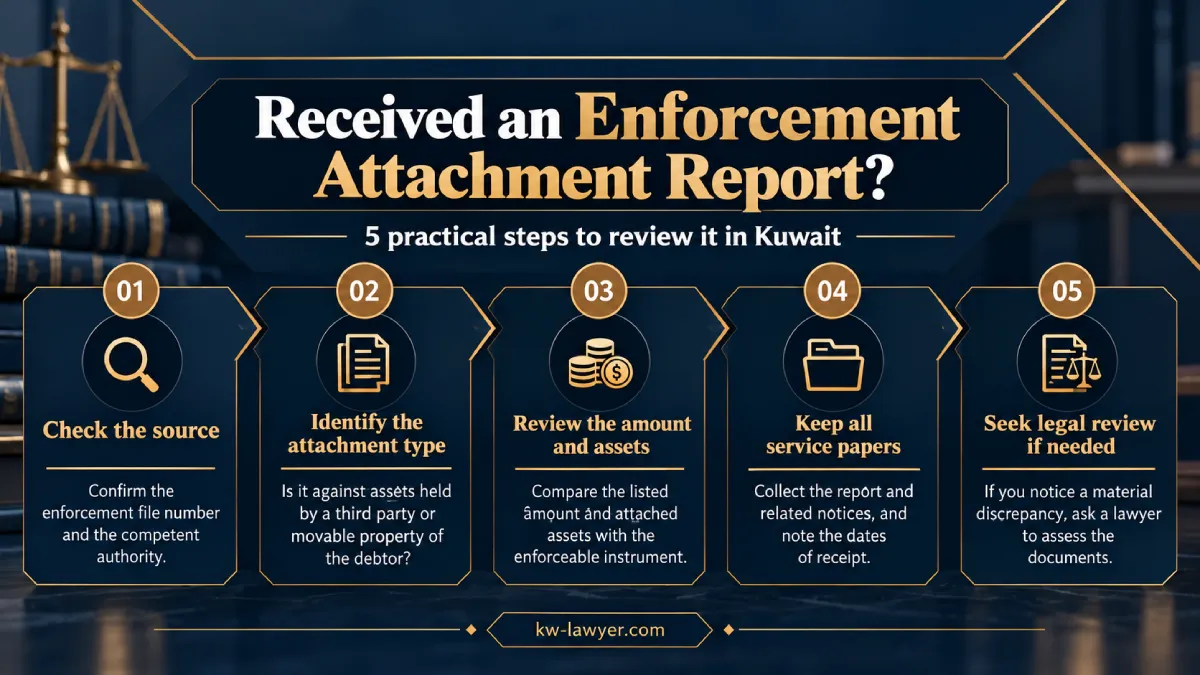
A bank notification may not explain the nature of the attachment or the instrument on which it is based. You should therefore examine the official documents before assessing the measure. Start with the following steps:
- Verify the source of the report: Check the enforcement case number and the competent authority, and confirm that the document relates to your case.
- Identify the type of attachment: Determine whether it concerns assets held by a third party or movable property in the debtor’s possession, as each is governed by different legal rules.
- Review the amount and attached assets: Compare the amount and assets identified in the report with the enforceable instrument and the information relating to the attachment.
- Keep all service documents: Collect the report and any related notices, and record their dates of receipt to check the applicable legal deadlines.
- Seek a legal review when necessary: If you identify a material discrepancy in the details or procedures, ask a lawyer to assess the documents and your legal position.
What Is the Difference Between Third-Party Attachment Documents in Kuwait?
Documents used to attach assets belonging to a debtor but held by a third party serve different purposes at different stages. An application for attachment is not the same as the report documenting an attachment-related measure. Likewise, an attachment notice differs from the third party’s statement of assets or debts held.
The Kuwaiti Ministry of Justice uses the term “Enforcement Attachment Report for Assets Held by a Third Party” in its classifications of General Department of Enforcement procedures. This form of attachment concerns funds or rights belonging to the debtor but held by another person or entity, such as a bank or an organization that owes money to the debtor.
Articles 227 and subsequent provisions of the Kuwaiti Civil and Commercial Procedures Law govern the attachment of assets held by third parties. Article 230 specifies the information that must appear in an attachment notice served on the party holding those assets.
The following table explains the purpose of each document:
| Document | Purpose |
|---|---|
| Application for enforcement attachment of assets held by a third party | A request to initiate an attachment measure in accordance with the prescribed legal requirements |
| Enforcement Attachment Report for Assets Held by a Third Party | A document recording an attachment-related measure within the enforcement case file |
| Attachment notice served on the third party | The notice addressed to the party holding the debtor’s assets under Article 230 |
| Statement of assets or debts held | A statement submitted by the third party concerning the assets or rights it holds, as required by law |
It is important to establish which stage the procedure has reached. Filing an attachment application does not, by itself, prove that the required notice has been served or that all legal conditions have been satisfied. Review the most recent recorded step in the case file before determining the attachment’s effect on the debtor’s assets.
Required Information in a Third-Party Attachment Notice in Kuwait
Article 230 of the Kuwaiti Civil and Commercial Procedures Law specifies the information that must appear in an attachment notice addressed to a third party. Key requirements include:
- Legal basis: A copy of the judgment, enforceable instrument or judicial authorization supporting the attachment, or the order assessing the debt, as applicable.
- Amount claimed: The principal amount for which the attachment is made, together with any associated amounts.
- Assets covered by the attachment: Identification of the asset where the attachment concerns specific property, together with an instruction prohibiting the third party from paying or delivering it to the debtor.
- Creditor’s details: The attaching creditor’s residence or place of business and, where required, an address for service in Kuwait.
- Legal instruction: A requirement that the third party submit a statement of the assets or debts it holds within the time limit and in the manner prescribed by law.
These details do more than identify the parties and the assets involved. The same article provides for invalidity if the information specified in paragraphs (a), (b) and (c) is omitted, subject to the rules governing who is entitled to invoke that invalidity.
Does an Enforcement Attachment Report Cover All of the Debtor’s Assets?
The issuance of an attachment report does not automatically mean that all the debtor’s assets are attached. The scope of the measure depends on the type of attachment, the assets covered, and the party holding them.
Article 227 of the Civil and Commercial Procedures Law addresses the scope of attachment over assets held by third parties, including cases where the attachment is not limited to a specifically identified movable asset or debt.
In addition, Decree-Law No. 59 of 2025 amended the second paragraph of that article and regulated how assets and debts falling within the attachment are treated, including amounts subsequently received by the third party under the amended provisions.
To determine which assets are affected, examine the attachment notice and the information concerning the funds or rights held by the third party, taking account of Article 227 as amended.
Legal Deadlines for Third-Party Attachment in Kuwait
Legal deadlines affect the validity of attachment procedures and their consequences. It is therefore essential to distinguish between the time limit for notifying the debtor of the attachment and the deadline for the third party’s statement of assets or debts held. Each relates to a separate obligation.
Articles 230 and 231 of the Civil and Commercial Procedures Law regulate these deadlines in cases involving assets held by third parties.
| Procedure | Legal Deadline |
|---|---|
| Notifying the debtor of an attachment over assets held by a third party | Within eight days following service of the attachment notice on the third party, under Article 231 |
| The third party’s statement of assets or debts held | Within ten days of being served with the attachment notice, under Article 230 as amended in 2025 |
Article 231 provides that the attachment is deemed never to have taken effect if the debtor is not notified within the statutory period.
Decree-Law No. 59 of 2025 also regulates submission of the statement to the Enforcement Department handling the proceedings, as well as the reporting of additional assets or balances received under the amended wording of Article 230.
Required Details in a Report on the Attachment of Movable Property Held by the Debtor in Kuwait
The information required when attaching movable property in the debtor’s possession differs from the requirements for assets held by third parties. Article 242 of the Civil and Commercial Procedures Law governs the preparation of a movable-property attachment report and requires certain details to be recorded at the place where the attachment takes place.
These include the enforceable instrument, the location of the attachment, the steps taken by the enforcement officer, and any obstacles or objections encountered during the procedure.
The report must also describe the attached items, estimate their value, specify the date and place of sale, and bear the enforcement officer’s signature.
Under Article 242, movable items become subject to attachment as soon as they are listed in the report, even if they remain in their original location. If the attachment takes place in the debtor’s absence and away from the debtor’s home or workplace, the report must be served on the debtor within no more than seven days following the attachment.
What Are the Ministry of Justice Requirements for Applying for Third-Party Attachment?
Attachment is one of the measures that may be taken during the enforcement of judgments in Kuwait. Through its Application to Attach Assets Held by a Third Party service, the Ministry of Justice explains the required documents, fees and approximate processing times.
According to the Ministry of Justice, documents required for this service include the defendant’s civil ID, copies of the judgments and the claimant’s power of attorney if the application is submitted through a representative.
The application can be submitted through the Ministry’s online services by signing in and selecting remote enforcement procedures, or by contacting the competent Enforcement Department through the channels available for the service.
Official Service Information — Last Checked: October 24, 2026
| Item | Ministry of Justice Information |
|---|---|
| Service name | Application to Attach Assets Held by a Third Party |
| Published government fees | None |
| Estimated time to submit the application | 10 minutes |
| Estimated time to carry out the attachment | 5 days |
| Competent authority | Enforcement Departments in Kuwait’s governorates |
This information applies specifically to the attachment application service described above; it does not mean that all attachment transactions are exempt from fees. The published estimated times do not guarantee completion within those periods, nor do they replace the statutory deadlines for service of notices.
When Do You Need a Lawyer to Review an Enforcement Attachment Report?
Legal review becomes particularly important if the attachment prevents you from using assets you need, or if a dispute arises over the amount claimed or the scope of the attachment. Depending on the nature of the dispute, challenging the attachment procedure may require an assessment of whether an objection to enforcement is appropriate. A creditor may also need to confirm that the procedures are valid before taking further steps.
A lawyer in Kuwait can help examine the report and related notices, assess the legal implications of any irregularities, and identify the appropriate next step based on the available documents, without guaranteeing a particular outcome.
Frequently Asked Questions About Enforcement Attachment Reports in Kuwait
Is a bank notification sufficient to establish a valid attachment?
A bank notification alone may not show the legal basis, scope, or procedural status of an attachment in Kuwait. Review the official attachment notice, the enforceable instrument, and the enforcement file before drawing conclusions. The validity of the measure depends on the applicable legal requirements and how the documents were served.
What if the debtor learns about the attachment after eight days?
Under Article 231 of Kuwait's Civil and Commercial Procedures Law, the debtor must be notified within eight days following service of the attachment notice on the third party. If that statutory deadline is missed, the attachment is deemed not to have taken effect. The dates and evidence of service should be checked.
May an attachment affect money deposited after the first notice?
It may, depending on the scope of the attachment and the amended provisions of Article 227. Decree-Law No. 59 of 2025 addresses assets and debts that may subsequently come into the third party's possession. The attachment notice and records should be examined before determining whether a later deposit is covered.
Are movable items still attached if they remain with the debtor?
Yes. Under Article 242 of the Kuwaiti Civil and Commercial Procedures Law, movable items become subject to attachment once they are recorded in the attachment report, even if they are not removed. If attachment occurs in the debtor's absence away from home or work, the report must be served within seven days.
The legal consequences of an Enforcement Attachment Report vary according to the type of attachment and whether the required procedures and legal conditions have been met. The appropriate course of action therefore depends on what the documents establish in each case.
If you identify discrepancies in the report or are uncertain about the scope of the attachment, you can schedule an appointment with Lawyer Fahad Ahmed Al-Saeed to review the documents and assess your legal position.
Related Legal Articles:
- Lifting a Travel Ban in Kuwait: When does a travel ban cease to apply, and what steps are required to lift it?
- Enforcing a Foreign Judgment in Kuwait: When can a foreign judgment be recognized for enforcement, and how do you begin the process?
Legal Disclaimer: This article provides general legal information for awareness purposes in the State of Kuwait. It is not legal advice tailored to any specific case, and reading it does not create a lawyer-client relationship. Procedures and outcomes vary according to the facts, documents and applicable laws.

A lawyer in Kuwait (Registration No. 3097) specializing in Court of Cassation cases, constitutional lawsuits, and litigation management. Through this personal platform, he provides precise and methodical legal explanations of litigation procedures and the principles of drafting legal memoranda. His aim is to provide readers with clear procedural knowledge to protect their rights and reduce the risks arising from procedural errors and missed legal deadlines