

Have you obtained a court judgment in your favor but still have not received what you are owed? A judgment is an important step, but enforcing your rights requires completing the necessary legal procedures. The process of Enforcement of Judgments in Kuwait begins by confirming that the judgment is enforceable, obtaining an enforceable copy, and serving the judgment debtor through the competent Enforcement Department.
These procedures may be delayed by missing documents, unsuccessful service, or the judgment debtor’s refusal to comply. The appropriate response depends on the nature of the obstacle and the stage reached in the enforcement process, in accordance with the Kuwaiti Civil and Commercial Procedures Law.
Has your enforcement case stalled at the service or attachment stage, leaving you unsure what to do next? Lawyer Fahad Ahmed Al-Saeed can review your judgment and enforcement proceedings, explain the available legal options, and help you identify the next appropriate step based on your case.
Request an Enforcement Case Review
Or continue reading to learn about enforcement procedures in Kuwait.
Procedures for the Enforcement of Judgments in Kuwait
Compulsory enforcement of civil and commercial judgments requires an enforceable instrument that meets the legal requirements and has been served on the judgment debtor in accordance with the prescribed procedures. The Enforcement Departments of the Ministry of Justice process applications and take the measures permitted by law, depending on the nature of the judgment and the obligation to be enforced.
Decree-Law No. 38 of 1980, promulgating the Civil and Commercial Procedures Law, as amended, governs the rules of compulsory enforcement.
Judgments subject to provisional enforcement or under appeal may require legal review before enforcement begins. In such cases, an enforcement lawyer in Kuwait can help assess how these circumstances affect the procedures available.
What Are the Steps for Filing an Enforcement Application?
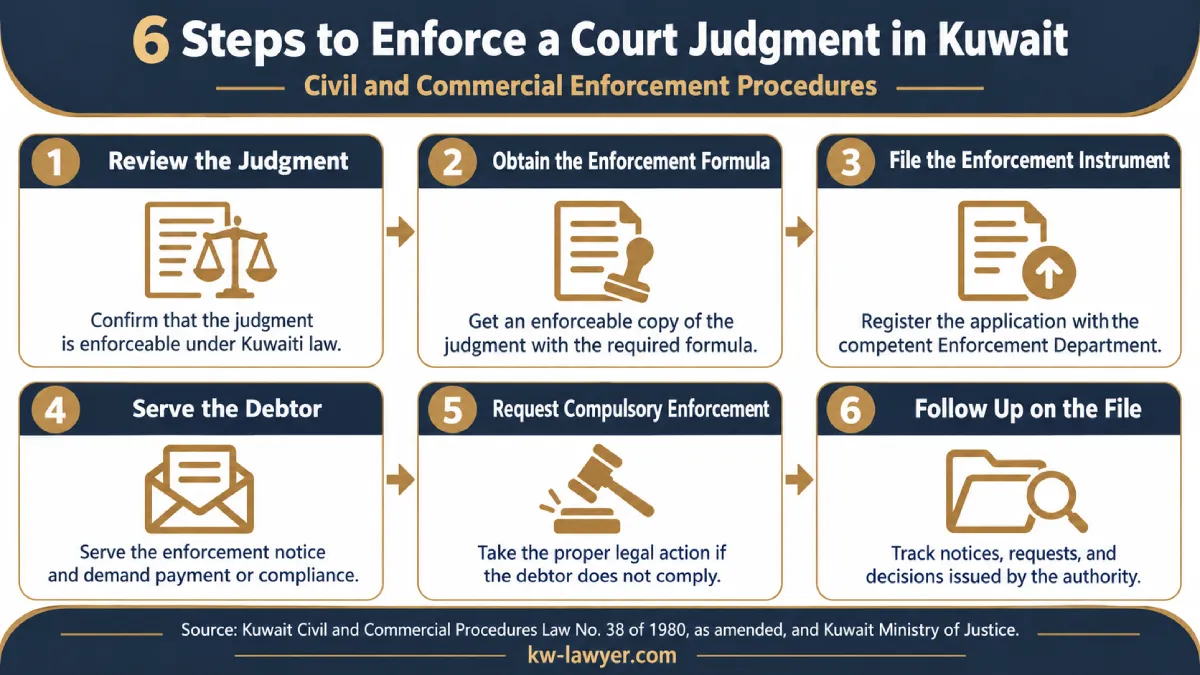
The enforcement of a civil or commercial court judgment involves several connected stages. Completing each stage determines whether the process can move to the next:
- Review the judgment: Confirm that it is enforceable, whether it has become final or is subject to provisional enforcement in cases permitted by law.
- Obtain an enforceable copy: Request a copy of the judgment bearing the required enforcement formula from the competent judicial authority.
- Submit the enforceable instrument: File the documents with the competent Enforcement Department and complete the case registration procedures.
- Serve the judgment debtor: Serve the enforceable instrument as required by law, specifying the obligation and demanding compliance.
- Apply for compulsory enforcement: Seek the appropriate measure, such as attachment of assets, if the debtor fails to comply and the legal conditions are met.
- Follow up on the enforcement file: Review applications, service notices, and issued decisions, and address any obstacle preventing the process from moving forward.
Article 204 of the Civil and Commercial Procedures Law requires service of the enforceable instrument before enforcement. Enforcement proceedings may not begin until five days have elapsed from the date the debtor receives the notice, subject to the applicable legal provisions.
To make this stage easier, the Kuwaiti Ministry of Justice provides the service for the enforceable copy of a judgment through its Enforcement Departments. Applications may also be submitted electronically through its remote enforcement procedure services.
Documents Required to Enforce a Judgment in Kuwait
Proper preparation of documents is essential for the Enforcement of Judgments in Kuwait. A missing document or unclear information about the judgment debtor can delay the application, particularly at the service stage.
Requirements vary by procedure. For service of an enforceable judgment, the Ministry of Justice states that the original judgment bearing the enforcement formula must be submitted together with the following documents and information:
| Document or information | Purpose |
|---|---|
| Original judgment bearing the enforcement formula | Establishes the existence of the instrument to be served |
| Claimant’s Civil ID | Verifies the applicant’s identity |
| Defendant’s address | Enables the competent authority to serve the documents |
| Power of attorney, where required | Establishes the representative’s authority to submit the application |
If the case proceeds to asset attachment, additional documents may be required, such as copies of judgments or a power of attorney when an authorized representative handles the procedure, depending on the requirements for the particular application.
You should therefore consult the official requirements for each procedure, especially when moving from service to attachment.
Fees and Timeframes for Enforcing Judgments in Kuwait
Not all enforcement procedures take the same amount of time. Service may be completed within days, while recovering a judgment debt can take longer, particularly if the debtor refuses to pay or attachment proceedings are needed.
Information verified on October 18, 2026, against details published by the Kuwaiti Ministry of Justice.
| Procedure | Published fees | Approximate timeframe |
|---|---|---|
| Service of the judgment bearing the enforcement formula | None | Approximately 3 days for service |
| Application to attach debts or assets held by a third party | None | Approximately 10 minutes to submit the application and 5 days to carry out the attachment |
These figures apply only to the two procedures listed. They do not necessarily mean that all enforcement procedures are free of expenses or completed within the same periods.
The timeframes shown in the table also do not mean the debt will be recovered within those periods. A debtor’s refusal to pay may require compulsory enforcement measures.
What Can You Do If the Judgment Debtor Refuses to Comply?
If the debtor continues to refuse compliance after the legal requirements have been fulfilled, it may be necessary to consider the available compulsory enforcement measures to recover the awarded amount. For monetary judgments, possible measures include:
- Attachment of the debtor’s assets: Where the assets are legally subject to attachment and the relevant conditions are met.
- Third-party debt attachment: Where the requirements are met to attach the debtor’s rights or assets held by another party.
- Requesting disclosure of the debtor’s assets: In accordance with the powers and procedures prescribed by law for the competent enforcement authority.
Decree-Law No. 59 of 2025 introduced Article 204 bis into the Civil and Commercial Procedures Law. It permits the Director of the Enforcement Department, or assisting judges, at the creditor’s request and after the debtor has been served but has failed to comply, to take steps to identify the debtor’s assets and rights held with government bodies, banks, and other entities.
This measure can help where it is difficult to identify assets available for enforcement. However, submitting the request does not give the creditor direct access to the debtor’s financial records. The process remains subject to legal safeguards and decisions of the competent authority.
Why Is Enforcement of a Judgment Delayed in Kuwait?
Delays in the Enforcement of Judgments in Kuwait do not necessarily mean that recovery is impossible. They may result from incomplete service, missing documents, or a procedural step requiring a decision from the competent authority. Identifying the cause helps determine the next appropriate action.
| Problem | What to check |
|---|---|
| Enforcement proceedings have not started | Whether the enforcement formula has been obtained and the judgment is enforceable |
| Service on the judgment debtor was unsuccessful | The accuracy of the address and other details, and the outcome of the service attempt |
| The debtor has not paid after service | Whether the statutory waiting period has expired and compulsory enforcement may be requested |
| The debtor’s assets cannot be located | Whether the conditions for requesting disclosure of assets are satisfied |
| An enforcement dispute has arisen | The nature of the dispute and the effect of the court decision relating to it |
Disputes may arise during enforcement concerning the validity of the procedures or whether they may continue. In some cases, these are known as objections to enforcement. Filing such an objection does not necessarily suspend enforcement; its effect depends on the applicable law and any court decisions issued in the matter.
Reviewing the latest action recorded in the file helps establish whether a delay is administrative or involves a legal issue requiring a decision by the competent authority.
How Can You Check the Status of an Enforcement Case in Kuwait?
Tracking the Enforcement of Judgments in Kuwait helps creditors understand the progress of their cases and identify possible delays. Checking the enforcement file status can reveal the current procedural stage and whether further action with the Enforcement Department is required.
You can check the case status by following these steps:
- Visit the enforcement case number inquiry service.
- Enter the enforcement case number in the designated field.
- Select the relevant enforcement authority from the available list.
- Enter the verification code and submit the inquiry.
- Review the information displayed and determine whether further follow-up is needed.
Keep the case number and inquiry results for reference when following up with the competent Enforcement Department.
When Do You Need an Enforcement Lawyer in Kuwait?
Enforcement obstacles vary. Some can be resolved by completing a straightforward procedural step, while others require legal review to avoid delaying recovery. Assistance from a lawyer in Kuwait may be particularly useful in the following situations:
- Unsuccessful service on the judgment debtor: To review why service failed and identify the appropriate next step.
- Continued refusal to pay: To assess the compulsory enforcement measures permitted by law.
- Difficulty locating the debtor’s assets: To consider whether asset disclosure or attachment may be requested.
- An enforcement dispute or related travel ban: To assess its legal effect and consider procedures for lifting a travel ban in Kuwait where the relevant grounds exist.
Frequently Asked Questions About the Enforcement of Judgments in Kuwait
Can a court judgment be enforced while an appeal is pending?
A pending appeal does not always prevent enforcement in Kuwait. The outcome depends on whether the judgment is legally enforceable and whether provisional enforcement is permitted. Any court order suspending enforcement must also be considered. Before proceeding, the judgment creditor should verify the judgment’s enforceability and the effect of any pending appeal.
Is there a waiting period before compulsory enforcement begins?
Yes. Article 204 of Kuwait’s Civil and Commercial Procedures Law generally requires the enforceable instrument to be served on the debtor before enforcement begins. Compulsory enforcement cannot normally start until five days have passed from the debtor’s receipt of the notice. The applicable legal provisions and circumstances of the case must still be considered.
Can a creditor recover money if the debtor has no known assets?
A creditor may request legally permitted measures to identify the debtor’s assets and rights. Article 204 bis, introduced by Decree-Law No. 59 of 2025, provides a mechanism for asset inquiries through the competent enforcement authority. However, identifying assets does not guarantee recovery, particularly if no attachable property or funds are available.
Does filing an enforcement objection automatically stop recovery?
Not necessarily. An objection concerning enforcement procedures does not automatically suspend the process in every case. Its effect depends on the applicable legal provisions and the decisions issued by the competent court. The parties should review the nature of the objection and any judicial order before assuming that enforcement must stop.
The process does not end when the court issues its judgment. The next stage requires obtaining an enforceable copy, completing service, and following up on the measures needed to secure compliance. Enforcement of judgments in Kuwait requires understanding the judgment, preparing the documents, and selecting the appropriate legal procedure at each stage.
If enforcement is delayed, start by reviewing the latest action recorded in your case and identifying the cause, whether it involves service, missing information, or a legal obstacle. You can book an appointment with lawyer Fahad Ahmed Al-Saeed to review your enforcement case and discuss the legal steps appropriate to your circumstances.
Legal disclaimer: This article provides general legal information to explain the procedures followed in Kuwait. It does not constitute legal advice tailored to your circumstances, and reading it does not create an attorney-client relationship. The appropriate procedure depends on the nature of the judgment, the available documents, and the specific circumstances of each case.

A lawyer in Kuwait (Registration No. 3097) specializing in Court of Cassation cases, constitutional lawsuits, and litigation management. Through this personal platform, he provides precise and methodical legal explanations of litigation procedures and the principles of drafting legal memoranda. His aim is to provide readers with clear procedural knowledge to protect their rights and reduce the risks arising from procedural errors and missed legal deadlines