
If a government authority has decided to terminate your employment, pass you over for promotion, or impose a disciplinary penalty, filing a grievance against an administrative decision may help you request a review. However, submitting a grievance requires careful attention to details that may affect your legal position, including the applicable deadline, the competent authority, and proof of submission.
This article explains when an administrative grievance is mandatory in Kuwait, how to submit one, the legal effect of an authority’s failure to respond, and when you may need to consult an administrative lawyer in Kuwait.
An administrative grievance is a request submitted by an interested party to the authority that issued a decision or to its superior administrative authority, seeking to have the decision reviewed, withdrawn, or amended. Under Kuwaiti law, it is a mandatory step before filing an annulment action in certain cases specified by law. Grievances against other decisions are governed by the general rules or any special legislation applicable to them.
Do you know when the deadline for challenging an administrative decision issued against you begins? Miscalculating that deadline may affect your ability to challenge the decision. You can contact a licensed lawyer to review when you became aware of the decision, examine the available documents, and assess the appropriate legal procedure for your situation.
Or continue reading to learn about grievance procedures and deadlines.
When Is a Grievance Against an Administrative Decision Mandatory in Kuwait?
The law does not require a prior grievance against every administrative decision. Whether a grievance is required depends on the nature of the decision, the legislation governing it, and whether filing an objection is a prerequisite to going to court.
Article 8 of Decree-Law No. 20 of 1981, as amended by Law No. 61 of 1982, identifies the decisions that must first be challenged through an administrative grievance before a court action seeking their annulment can be brought.
| Type of Administrative Decision | Grievance Requirement |
|---|---|
| Appointments to civilian public-sector positions | A prior grievance is mandatory |
| Promotions of civilian employees | A prior grievance is mandatory |
| Termination of civilian employees’ service | A prior grievance is mandatory |
| Imposition of disciplinary penalties | A prior grievance is mandatory, except for decisions issued by disciplinary boards, as provided by law |
| Other final administrative decisions | Article 8 does not, by itself, require a prior grievance against these decisions, subject to any special legal provisions |
This distinction is important when considering an action to annul a decision. Failure to submit a grievance in cases where the law makes it mandatory may result in the annulment claim being ruled inadmissible.
What Are the Legal Deadlines for Administrative Grievances in Kuwait?
When filing a Grievance Against an Administrative Decision, it is important to distinguish the period allowed for the administrative authority to respond from the deadline for filing an annulment action.
Under Article 7 of Decree-Law No. 20 of 1981, the deadline for filing an annulment action is 60 days. Depending on the circumstances, this period begins on the date the decision is published in the Official Gazette or government bulletins, formally notified to the interested party, or conclusively known to that party.
Submitting a grievance to the competent administrative authority in accordance with the law interrupts the time limit for filing an annulment action. The authority must decide the grievance within 60 days of its submission. If no response is given within that period, the grievance is deemed implicitly rejected. The time limit for filing an annulment action is then calculated from the date of express or implicit rejection, as applicable under the law.
Legal note: Not all grievances are governed by the same deadlines and procedures; certain legislation may contain special provisions. Moreover, submitting a grievance after the applicable deadline does not automatically reopen the period for bringing a court challenge.
What If I Received the Decision Some Time After It Was Issued?
If you were not notified of the decision immediately after it was issued, keep evidence showing the date on which you were informed, such as notices and official correspondence. These records may help establish when the legal time limit began if a dispute arises over when you became aware of the decision.
Steps for Filing a Grievance Against an Administrative Decision
The Decree on Grievances Against Administrative Decisions, issued on October 5, 1981, in implementation of Article 8 of Decree-Law No. 20 of 1981, sets out how grievances within its scope must be submitted, as well as the information required for their registration and consideration.
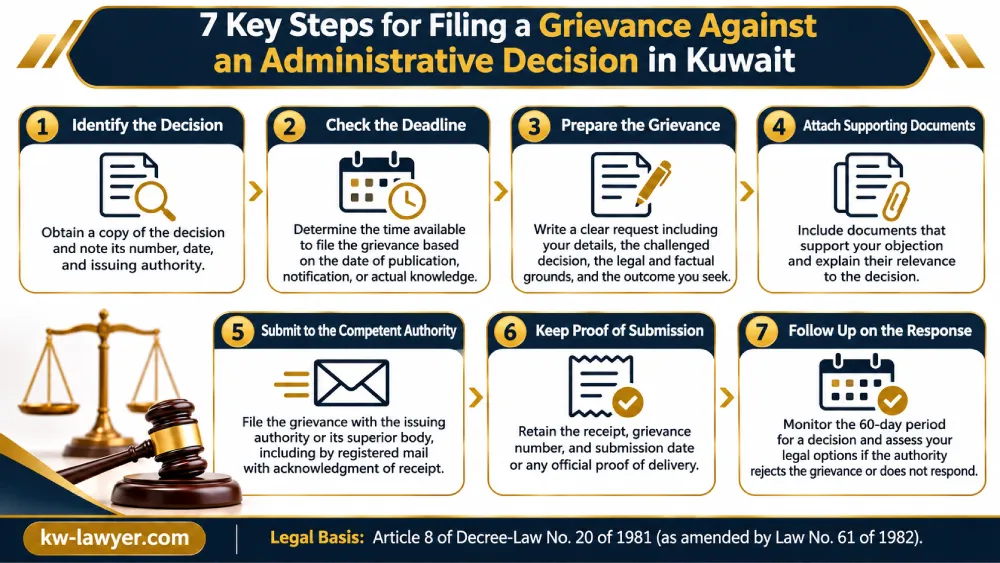
The main steps are as follows:
- Identify the decision being challenged: Obtain a copy of the decision or a document proving it was issued, then identify its number, date, and issuing authority.
- Check the legal deadline: Verify when the decision was published, notified to you, or conclusively brought to your attention, and determine the time available to take action.
- Prepare the grievance request: State your personal details, job title, and address. Identify the decision you object to, the grounds for your objection, and the outcome you seek from the administrative authority.
- Attach supporting documents: Include documents supporting the facts and grounds stated in your grievance, explaining how each relates to the decision.
- Submit the request to the competent authority: File the grievance with the authority that issued the decision or its superior authority. The decree also permits submission by registered mail with acknowledgment of receipt.
- Keep proof of submission: Retain the receipt showing the grievance number and submission date, or other proof that it was sent and received through the prescribed method.
- Follow up on the response: Monitor the submission date and the period allowed for a decision, so you can assess your position when a response is issued or the period expires without one.
How Should You State the Grounds for an Administrative Grievance in Kuwait?
The grounds of a grievance should explain to the competent authority why the decision is being challenged. They should therefore rely on specific facts and legal arguments that can be examined, rather than simply describing the decision as unfair.
Article 4 of Decree-Law No. 20 of 1981 identifies grounds for challenging certain categories of administrative decisions, including:
- Lack of jurisdiction: The decision was issued by an authority that had no legal power to issue it.
- Procedural or formal defect: The decision was issued in breach of a formality or procedure required by law.
- Violation of laws or regulations: The decision was based on an incorrect application or interpretation of legal provisions.
- Misuse of power: The administrative authority exercised its powers for a purpose other than the one intended by law.
For example, if an employee challenges a decision to pass them over for promotion, merely stating that they were more deserving of the promotion will not be enough. They should identify the legal or employment-related requirement they believe was incorrectly applied and provide documents supporting their position.
The existence of any of these grounds does not necessarily mean the grievance will be accepted. The outcome depends on the nature of the decision, whether the relevant facts can be established, and the validity of the legal grounds supporting the objection.
Documents Required for an Administrative Grievance in Kuwait
The documents required for a Grievance Against an Administrative Decision depend on the nature of the decision being challenged. The applicant may need the following records to support their objection and establish the facts on which it is based:
- A copy of the administrative decision being challenged.
- Proof of the date on which the decision was notified or became known.
- Personal and employment details required to submit the request.
- Documents supporting the grounds for the grievance.
- Official correspondence relating to the decision.
- A copy of the grievance request and proof of its submission or dispatch.
An employee challenging a promotion decision may need documents relating to their employment status and promotion requirements. Different records may be relevant when challenging a disciplinary penalty or a termination decision.
The value of supporting documents lies not in their number but in their ability to establish the facts and clarify the grounds for objection. It is therefore advisable to organize them and link each document to the argument it supports.
How Can You Prove You Submitted a Grievance If You Did Not Receive a Receipt?
An interested party may submit a grievance within the applicable deadline but later struggle to prove when the administrative authority received it. This can become significant if a dispute subsequently arises over compliance with the legal time limit.
Article 3 of the Decree on Grievance Procedures requires requests to be entered in a dedicated register under a serial number and a receipt to be issued showing the grievance number and submission date, or sent to the applicant by registered mail with acknowledgment of receipt.
If you submitted a grievance but did not receive a receipt, ask the competent authority for proof of its registration number and the date it was received. Keep any official correspondence confirming receipt, or proof of delivery if you used registered mail. These records may be important if a dispute later arises over the date the grievance was submitted.
Mistakes That May Affect the Admissibility of an Administrative Grievance in Kuwait
Certain mistakes may become apparent after a grievance is submitted, particularly when interpreting the administrative authority’s response or calculating deadlines for subsequent proceedings. These situations must be distinguished because their legal consequences may vary according to the applicable provisions.
| Common Mistake | How to Address It |
|---|---|
| Treating the authority’s failure to respond as approval of the grievance | Take account of the effect of implicit rejection once the legally prescribed period has expired |
| Confusing the period for deciding a grievance with the deadline for filing an annulment action | Calculate each period separately, using its legally prescribed starting date |
| Assuming that filing a late grievance automatically reopens the deadline for a court challenge | Check the legal effect of a late grievance under the applicable legislation |
| Relying on a verbal response without official proof | Keep the written response or documents establishing the relevant procedures and dates |
Procedural mistakes do not all have the same consequences. Missing information may require a different remedy from missing a statutory deadline. The effect of each mistake must therefore be assessed in light of the type of decision and the legal provisions governing grievances against it.
If the dispute proceeds to court, you may encounter terms such as a defense memorandum responding to the grievance and a defense memorandum arguing that the grievance deadline has expired. The former addresses the grounds for objection, while the latter concerns time limits and the consequences of missing them. These court submissions should be distinguished from the memorandum prepared by an administrative authority while examining a grievance, as their purposes and procedures differ.
When Should You Consult a Lawyer to Review an Administrative Grievance?
A Grievance Against an Administrative Decision may require legal review when it is unclear whether a prior grievance is mandatory, when the relevant deadline began, or whether the available evidence supports the grounds for objection.
A lawyer in Kuwait can review the grievance file, identify points that require evidence, assess how closely the grounds for objection are supported by the submitted documents, and explain the legal options available in light of the circumstances.
Legal review does not guarantee that a grievance will be accepted. It can, however, help the interested party understand their position more clearly and make an informed decision based on the facts and documents, rather than assumptions that may not reflect the applicable legal procedures.
Frequently Asked Questions About Grievances Against Administrative Decisions
Can I object if I am passed over for a civil-service promotion?
Yes. Under Article 8 of Kuwait’s Decree-Law No. 20 of 1981, a prior administrative grievance is required for certain decisions concerning promotions of civilian public employees before seeking judicial annulment. Identify the promotion decision, explain the alleged legal error, and keep documents supporting your position and the relevant dates.
Does a ministry’s silence mean my objection has been accepted?
No. For grievances governed by Kuwait’s Decree-Law No. 20 of 1981, the administrative authority must decide within 60 days after submission. Failure to reply within that period is treated as implicit rejection, not acceptance. The date of rejection can affect when the period for bringing an annulment action begins.
Can I send my objection by registered mail?
Yes. The decree regulating administrative grievance procedures permits submission to the authority that issued the decision or its superior authority, including by registered mail with acknowledgment of receipt. Keep the mailing record and proof of delivery, as they may be important if the date of submission is later disputed.
Do disciplinary board decisions follow the same grievance rule?
Not necessarily. Article 8 requires a prior grievance for certain disciplinary penalties but expressly excludes decisions issued by disciplinary boards under its wording. The distinction matters because the procedure for challenging a particular sanction depends on which body issued it and any special rules that apply to that decision.
Before filing a grievance against an administrative decision, check three essential points: Does the decision require a prior grievance? When does the legal deadline begin? How will you prove that the competent authority received your request? Answering these questions can help you choose and follow the appropriate procedure without overlooking details that may affect your legal position.
If your documents do not clearly establish when you became aware of the decision, or you are unsure how the administrative authority’s response affects your position, you can schedule an appointment with a licensed lawyer to review the documents and assess the available options.
Related Legal Articles:
Challenging Administrative Deportation in Kuwait: Cases and procedures.
Legal disclaimer: This article provides general legal information for educational purposes. It does not constitute individualized legal advice, and reading it does not establish a lawyer-client relationship. Procedures and deadlines may vary depending on the nature of the decision, the applicable legislation, and the circumstances of each case.

Kuwait Lawyer is a legal information and guidance platform in Kuwait. It publishes plain-language articles and guides to legal procedures and relevant authorities.