

A judgment in absentia can become more complicated if the convicted person takes the wrong procedural step or miscalculates the applicable time limit. Therefore, when considering an Opposition to a Judgment in Absentia in Kuwait, the first step is to examine the nature of the judgment, the manner in which it was served, and the date from which the legal time limit begins to run. These factors determine whether opposition is still available before moving on to prepare the grounds and supporting documents.
If it is unclear whether opposition is the appropriate remedy, or if the judgment has entered a different procedural stage, an appeals lawyer in Kuwait can review the type of judgment and the sequence of previous proceedings to identify the legal route that should be considered.
Has a judgment in absentia been issued against you, and are you concerned about missing the opposition deadline or taking the wrong procedural step? Lawyer Fahad Ahmed Al-Saeed can review the judgment, its service, and the sequence of proceedings to determine whether opposition is still available and which legal step may be considered based on the circumstances of the case.
Or continue reading to understand the time limit and procedures before getting in touch
What Does Opposition to a Judgment in Absentia Mean in Kuwait?
Opposition is an ordinary method of challenging a criminal judgment issued in absentia. It brings the case back before the same court that issued the judgment, allowing the convicted person to present their defense.
Article 187 of the Criminal Procedure and Trials Law allows a person convicted in absentia in misdemeanor and felony cases to file an opposition, which is heard before the court that issued the judgment. The law regulates opposition proceedings in Articles 187 through 198.
However, a person’s absence from certain hearings does not automatically mean that every judgment issued in their absence may be challenged by opposition. The classification and nature of the judgment, as well as the procedural stage at which it was issued, must first be verified because this remedy is subject to conditions established by law.
What Is the Time Limit for Opposing a Judgment in Absentia in Kuwait?
The law sets a one-week time limit for filing an opposition to a judgment in absentia. Under Article 188, as amended by Law No. 62 of 2025:
- In misdemeanor cases, the time limit begins from the date the judgment in absentia is served on the convicted person.
- In felony cases, it begins from the date the convicted person is arrested if the judgment has not been personally served on them.
- If the time limit expires without an opposition being filed, this remedy is no longer available, although an appeal may still be considered if the judgment is appealable.
For this reason, the period should not be calculated from the date you informally heard about the judgment or learned of it from another person. The review should begin with the service document, how service was carried out, the type of case, and whether the judgment was personally served on the convicted person in accordance with the situation regulated by law.
This becomes particularly important when a person believes that more time remains, while the legal period may in fact have already started from another date recognized by law.
How Do You File an Opposition to a Judgment in Absentia in Kuwait?
Article 189 of the same law provides that an opposition must be filed by a petition submitted to the court registry of the court that issued the judgment. It must be signed by the convicted person or their representative and must include the details of the judgment and case, the grounds of opposition, and the requested relief.
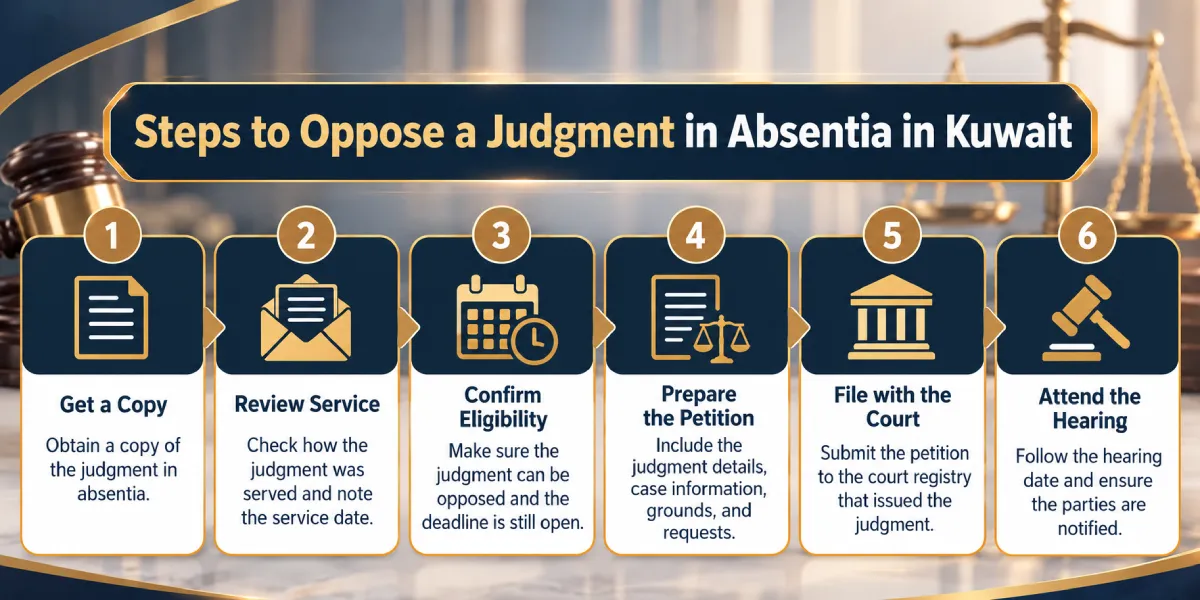
In practice, the opposition generally passes through the following main stages:
- Obtain a copy of the judgment in absentia.
- Review the service of the judgment and the date on which service occurred.
- Confirm that the judgment is open to opposition and that the time limit has not expired.
- Prepare the petition, including the judgment and case details, grounds, and requested relief.
- Submit the petition to the registry of the court that issued the judgment.
- Schedule a hearing for the opposition and notify the parties of that hearing.
Article 190 provides that the president of the court orders a hearing to be scheduled for the opposition, while the court registry is responsible for notifying the convicted person and the other parties of the hearing date and the opposition petition.
What Documents Are Required to File an Opposition in Kuwait?
The Kuwaiti Ministry of Justice publishes an Opposition Appeal service through the Court Registry Department of the Court of First Instance and lists the following among the required documents:
- A copy of the judgment.
- The service notice of the judgment in absentia.
- Personal attendance or attendance by an authorized representative.
The Ministry also states that no fees are charged for the service and that the published processing time is approximately 3 to 5 minutes. This period relates only to registering the transaction with the competent authority. It does not indicate how long the court will take to hear the opposition or issue a decision.
Before Going to Court
It is preferable to prepare a more complete case file containing:
- The case number and basic case details.
- A complete copy of the judgment, not only its operative part.
- The service document and proof of its date.
- Any relevant previous memoranda.
- Documents related to the defense.
- Any documents that may affect the explanation for the absence or the validity of the proceedings.
Not all of these documents may be required to complete the administrative registration, but they become important when reviewing the case file and identifying possible defense arguments.
When May the Court Rule an Opposition Inadmissible?
Article 193 identifies circumstances that may lead to an opposition to a judgment in absentia being declared inadmissible, including:
- Filing the opposition after the legal time limit has expired.
- Lack of legal standing on the part of the person filing it.
- The existence of a material formal defect.
For this reason, it is generally inappropriate to begin by drafting a lengthy defense before confirming that these requirements have been satisfied. The convicted person may have strong arguments on the merits of the case, but the court first considers whether the opposition remedy was exercised in accordance with the law.
Before filing, four points should be checked: Is the judgment open to opposition? When did the time limit begin? Does the person filing the opposition have legal standing? Does the petition contain the required basic information?
What Happens After an Opposition to a Judgment in Absentia Is Accepted?
If the court accepts the opposition procedurally, it proceeds to hear the opposing party’s statements and requests, as well as the responses of the other parties. The court may also take any investigative measures or hear witnesses where permitted by law.
The opposition may result in the judgment in absentia being upheld if the court finds it correct, set aside if a defect affecting it is established, or modified by reducing the sentence within the limits permitted by law.
Article 197 establishes an important rule: an opposition may not place the person filing it in a worse position. Accordingly, the penalty imposed by the judgment in absentia may not be increased merely because the convicted person exercised the right to file an opposition.
What Happens If You Do Not Attend the Opposition Hearing?
Article 192 provides that if the person filing the opposition fails to attend the first hearing scheduled to consider it, the court will rule that the opposition is deemed as though it had never been filed. If an appeal is available, the time limit for filing it begins from the date that ruling is pronounced.
However, this consequence depends on whether the person filing the opposition was properly notified of the hearing. The Kuwait Institute for Judicial and Legal Studies has cited a Court of Cassation ruling indicating that the legal consequences of absence require valid notification of the opposition hearing date.
Therefore, filing the petition and simply waiting for the outcome is not enough. The hearing date should be followed closely, and the information relating to service and attendance should be verified.
Why Should the Service of the Judgment Be Reviewed?
Article 188, as amended, allows a judgment in absentia to be served personally on the convicted person or through electronic means and modern communication methods that can be stored and retrieved, subject to the applicable legal requirements. It also regulates the procedure where service cannot be completed.
Reviewing the service is not limited to identifying its date. It also involves checking the method used, the information recorded in the service document, and whether the process complied with the procedures prescribed by law, because defects in service may have different procedural consequences depending on the circumstances of the case.
This review becomes particularly important when a person discovers the judgment only after some time has passed. In that situation, the issue is not merely the date on which the person became aware of the judgment, but the date recognized by law as the starting point of the applicable time limit.
Is Opposition to a Judgment in Absentia Different from Other Methods of Challenge?
The same legal remedy does not apply to every judgment. The appropriate procedure varies depending on the type and level of the judgment, the stage of the proceedings, and the grounds on which the challenge is based.
An opposition to a judgment in absentia differs from a petition for reconsideration under Kuwaiti law, because each remedy has its own legal grounds and requirements.
Opposition also differs from filing an original nullity action, which operates within a different legal framework and is not used merely because the convicted person disagrees with the judgment.
An appeal before the Court of Cassation under Kuwaiti law is also an independent method of challenge with its own requirements and procedural stage. It does not automatically replace opposition.
If opposition is no longer available or its time limit has expired, another legal remedy may need to be considered after reviewing the judgment, its level, and the procedures already taken.
Mistakes That May Affect an Opposition to a Judgment in Absentia
Many procedural problems arise before the merits of the case are even considered. Mistakes that should be avoided include:
- Delaying the process of obtaining the judgment and its service documents.
- Relying on the date you became aware of the judgment without reviewing the document that legally triggers the time limit.
- Beginning to prepare the opposition before confirming the classification of the judgment and the stage at which it was issued.
- Filing the petition before reviewing the judgment details, case information, and the requested relief stated in it.
- Failing to retain proof that the opposition was registered and failing to follow up on the hearing details after filing.
- Relying on an incomplete copy of the judgment or service document.
- Confusing opposition with appeal or cassation.
- Submitting general grounds that are not connected to the judgment or the facts of the case.
Paying attention to these points does not guarantee a particular outcome, but it reduces the risk of making a procedural mistake that could have been avoided from the outset.
When Should You Seek a Legal Review of a Judgment in Absentia?
A legal review becomes particularly important if you have only recently received the judgment, if the date of service is unclear, or if little time remains before the deadline expires.
Lawyer Fahad Ahmed Al-Saeed can review the judgment, its service, and the sequence of proceedings to determine whether an opposition to a judgment in absentia remains a legal option worth considering and which documents should be prepared before taking the next step.
A review may be especially useful where there is difficulty determining the starting date of the time limit, doubt regarding the validity of service, or uncertainty about the classification of the judgment and its procedural stage.
Frequently Asked Questions About Opposition to a Judgment in Absentia
Can someone else submit the opposition petition for the convicted person?
Yes. Under Article 189 of Kuwait’s Criminal Procedure and Trials Law, the opposition petition may be signed and submitted by the convicted person or by someone acting on their behalf. The petition should contain the relevant judgment and case details, the grounds of opposition, and the relief requested from the court.
Which court receives an opposition petition in Kuwait?
The petition is submitted to the registry of the same court that issued the judgment in absentia. After filing, the president of the court orders a hearing date to be scheduled. The court registry then handles notification of the convicted person and the other parties regarding the petition and hearing date.
Does hearing about the judgment informally start the one-week period?
Not necessarily. The legal starting point should be determined by examining how the judgment was served and the type of criminal case involved. Informal knowledge through another person does not by itself replace the service rules established by law. The service document should therefore be reviewed before calculating the opposition deadline.
Can the penalty be increased because the convicted person filed an opposition?
Article 197 establishes that an opposition must not prejudice the person who filed it. Accordingly, the penalty contained in the judgment in absentia cannot be increased merely because the convicted person exercised the right to oppose that judgment. The court may nevertheless review the case within the legal scope of the opposition proceedings.
What should be kept after an opposition petition is filed?
Keep evidence showing that the opposition was properly registered, together with the petition, the judgment, the service documents, and the scheduled hearing details. These records help confirm what was filed and when. The hearing date should also be monitored carefully because failure to attend may have procedural consequences under Kuwaiti law.
An opposition to a judgment in absentia requires prompt action, but acting quickly does not mean filing before understanding the case file. Begin by reviewing the judgment, its service, the date on which the time limit started, legal standing, and the formal requirements. Then prepare the grounds of opposition and the documents supporting them. Reviewing the file with a lawyer in Kuwait may help confirm that the required documents have been assembled before taking procedural action.
If you have collected the judgment, its service documents, and the documents related to the case, you can send them to schedule an appointment for a consultation with lawyer Fahad Ahmed Al-Saeed before taking the next step.
Disclaimer: This content is provided for general legal awareness only. It does not constitute legal advice for any individual case, and reading it does not create an attorney-client relationship. Whether a judgment may be challenged by opposition, how the time limit is calculated, and which procedure is appropriate depend on the judgment, the facts of the case, and the available documents.

A lawyer in Kuwait (Registration No. 3097) specializing in Court of Cassation cases, constitutional lawsuits, and litigation management. Through this personal platform, he provides precise and methodical legal explanations of litigation procedures and the principles of drafting legal memoranda. His aim is to provide readers with clear procedural knowledge to protect their rights and reduce the risks arising from procedural errors and missed legal deadlines