
At first, the situation may seem straightforward: you have an earlier judgment that settled the dispute, or decided a fundamental issue within it, and then a later judgment addressed the same matter again or reached a different conclusion.
However, the existence of two different judgments does not automatically mean that the dispute has already been decided. What matters is whether the first judgment has res judicata effect and whether the parties, subject matter, and cause are the same in both cases.
Therefore, when preparing a Res judicata annulment claim, starting with a ready-made template is not the correct approach. The first step is to identify the issue decided by the earlier judgment, establish its binding effect, and explain where the later judgment revisited or conflicted with that issue.
The legal review should therefore begin by examining both judgments and assessing the effect of the earlier one, with the assistance of an appeals lawyer in Kuwait when it is necessary to determine the appropriate legal route before taking any action.
Has a judgment been issued against you even though you believe an earlier judgment already settled the same dispute? Lawyer Fahad Ahmed AlSaeed can review both judgments and compare the parties, claims, and grounds to determine whether res judicata affects your legal position and what legal route may be appropriate before taking any action.
Or continue reading first to learn when res judicata applies and how to compare the two judgments.
What Does a Res Judicata Annulment Claim Include in Kuwait?
A Res judicata annulment claim is not based merely on saying that an old judgment contradicts a new one. It is not enough to refer to the existence of an earlier judgment; the claim should be built on specific elements that can be compared against the records of both cases.
In practice, the claim should begin with five connected points:
- Identify the earlier judgment relied upon by the concerned party.
- Identify the issue decided by that judgment.
- State the parties to both disputes and their legal capacities.
- Compare the subject matter and cause of the earlier claim with the later claim.
- Identify the point of conflict between what the earlier judgment settled and what the later judgment decided.
The more precise this comparison is, and the more closely it is supported by the documents from both cases, the clearer the assessment of res judicata becomes.
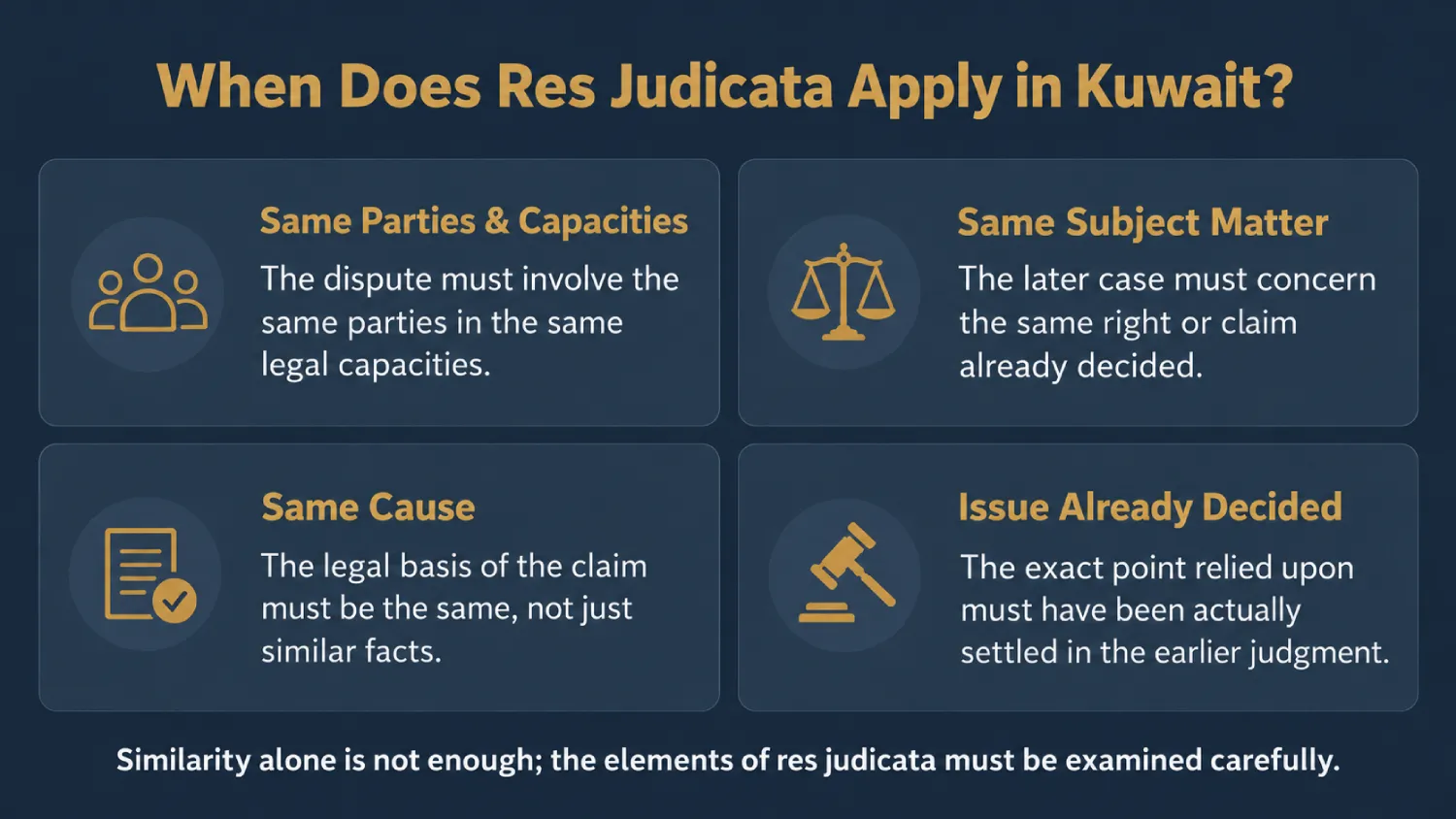
When Does Res Judicata Apply in Kuwait?
Article 53 of the Kuwaiti Evidence Law provides that judgments with res judicata effect are binding as to the rights they have decided. This effect applies only where the dispute is between the same parties without a change in their legal capacities and concerns the same right, subject matter, and cause. The court may also raise res judicata on its own motion.
Therefore, it is not enough for the two cases to resemble each other in name or in their general facts. The following elements must be examined:
- Parties and capacities: The legal capacity of each party must be considered, not merely the name. A person may appear in the first case in a personal capacity and then be a party to the second case as a representative of a company, estate, or another entity. That difference may affect the binding effect of the earlier judgment.
- Subject matter: The right or claim decided in the first judgment must be identified and compared with what is sought in the later case. The fact that both cases relate to the same contract or property does not necessarily mean that the subject matter is the same, because the right being claimed may differ from one case to another.
- Cause: The claims or facts may appear similar while the direct legal basis of the claim differs. For that reason, superficial similarity is not enough to establish res judicata if the cause of the right asserted in the later action differs from the cause on which the first dispute was based.
- Issue already decided: The point relied upon as having binding effect must actually have been decided in the earlier judgment. This is why reading the reasoning of the judgment is important alongside its operative part, as it helps define the limits of the issue considered and settled by the court.
How Do You Compare the Earlier Judgment with the Later Judgment?
Before preparing the claim, a brief comparison between the two judgments can be organized to identify the points of similarity and difference:
| Point of Review | Earlier Judgment | Later Judgment | Result |
|---|---|---|---|
| Parties and capacities | … | … | Same / Different |
| Claims | … | … | Same / Different |
| Right in dispute | … | … | Same / Different |
| Cause of claim | … | … | Same / Different |
| Issue already decided | … | … | Same / Different |
| Judicial outcome | … | … | Conflict / No conflict |
This table helps determine whether the later judgment decided the same issue again or whether the similarity between the two cases is only superficial.
How Should Res Judicata Be Pleaded in the Claim?
The claim should not be limited to a general phrase such as: “the case has already been decided by an earlier judgment.” It is better to identify the earlier judgment clearly, explain the issue it settled, and then show how that issue relates to the later dispute.
Identifying the Earlier Judgment
The judgment relied upon should be identified in a way that directly connects it to the current dispute. This will usually include the judgment number, the court that issued it, its date, the parties and their capacities, the claim that was decided, and the issue settled by the judgment.
Merely attaching the earlier judgment to the documents without explaining its relevance is not enough. The part relied upon as having res judicata effect should be identified and connected to the point raised again in the later dispute.
Explaining the Point of Conflict
After identifying the earlier judgment, the next step is to explain what the later judgment decided on the same issue and then clarify where the two judgments differ.
The presentation becomes clearer when the idea is arranged as follows:
- Earlier judgment: It settled a specific issue in a particular way.
- Later judgment: It returned to the same issue and reached a different judicial conclusion.
- Point of conflict: Identify the point at which the two outcomes cannot stand together if the res judicata effect of the first judgment remains binding.
A difference in the final result of the two judgments is not enough by itself. The conflict must concern the same issue that acquired res judicata effect in the earlier judgment.
What Documents Are Required to Establish Res Judicata?
It is not preferable to submit only the two judgments, because verifying whether the dispute is the same may require documents showing what was actually presented to the court. Important documents include:
- A complete copy of the earlier judgment.
- A complete copy of the later judgment.
- The statement of claim in the earlier case.
- The statement of claim in the later case.
- The final claims or relief sought in both cases.
- The written submissions showing the basis of each claim.
- Documents showing the legal capacity of the parties where there is a difference.
- Judgments related to the earlier dispute if it passed through more than one level of litigation.
- Documents showing the legal status of the earlier judgment where required.
These documents help answer a fundamental question: what was actually submitted to the first court, and what did that court decide? The official documents required when pursuing a specific route vary according to the procedure involved. The Kuwaiti Ministry of Justice sets out the statement of claim, supporting documents, and fees required for filing a non-criminal cassation appeal.
What Mistakes Can Weaken Reliance on Res Judicata?
A party may already have an earlier judgment, but the way res judicata is presented can weaken reliance on it if the elements of binding effect and the point of conflict are not identified precisely. Common mistakes include:
- Relying only on the similarity between the two cases: The fact that both disputes relate to the same contract or legal relationship does not mean that the subject matter and cause are identical. The right claimed and the basis of each action should be identified.
- Ignoring a difference in a party’s legal capacity: Similar party names are not enough if their legal capacities differ between the two cases. The capacity of each party should therefore be reviewed as it appears in both judgments and statements of claim.
- Failing to connect the earlier judgment to the later dispute: The earlier judgment may be cited correctly but without explaining how the issue it decided reappeared in the new case.
- Relying on a different outcome alone: Two judgments reaching different results does not establish a legal conflict unless both judgments concern the same issue that acquired res judicata effect.
- Retelling the dispute instead of establishing binding effect: The claim does not need to repeat the entire history of the case unless necessary. It is better to focus on the parties and their capacities, the subject matter, the cause, and the issue already decided.
Does Every Conflict with an Earlier Judgment Mean the Later Judgment Is Void?
No. The fact that a later judgment differs from an earlier one does not mean that every case should be handled through an independent nullity action. The nature of the judgment, the extent of the earlier judgment’s res judicata effect, and the appropriate legal route for challenging it should first be identified.
If reviewing the two judgments shows that the appropriate route is connected to a cassation appeal under Kuwaiti law, the conditions and procedures of that appeal should be examined. If the objection is instead based on another defect affecting the judgment itself, it may be appropriate to review the requirements for filing an original nullity action to determine whether they apply to the case.
In all cases, the existence of a ground for objection is not enough on its own. Choosing an unsuitable route or filing it without satisfying its requirements may result in the appeal being declared procedurally inadmissible in Kuwait.
How Can a Lawyer Help Review the Two Judgments?
A lawyer’s review focuses on determining whether res judicata applies and the extent to which the earlier judgment is binding in relation to the current dispute.
The importance of this review lies in the fact that the problem may not concern the underlying right itself, but rather the choice of a procedure that does not match the nature of the judgment, or presenting res judicata in a general way without clearly identifying the scope of its binding effect.
A lawyer in Kuwait handling this type of dispute reviews both judgments and the documents connected to them, identifies the issue that was previously decided, and then assesses the procedural route that fits the nature of the judgment and the status of the case.
Frequently Asked Questions About a Res Judicata Annulment Claim
Can two different judgments automatically establish res judicata?
No. Different outcomes alone do not establish res judicata. The earlier judgment must have binding effect, and the relevant dispute must involve the required identity of parties and capacities, subject matter, and cause. The issue relied upon must also have been actually decided in the earlier judgment.
Can the court raise res judicata without a party requesting it?
Yes. Under the rule explained in Article 53 of the Kuwaiti Evidence Law, the court may address res judicata on its own motion when its legal requirements are satisfied. This means the issue is not necessarily dependent solely on a party expressly raising it during the proceedings.
Is having the same parties in both cases enough?
No. The names of the parties alone are not sufficient. Their legal capacities must also be examined, together with the subject matter and cause of both disputes. A person appearing personally in one case and in another legal capacity in a later case may affect the application of res judicata.
Why is the reasoning of the earlier judgment important?
The reasoning can help identify the precise issue the court examined and settled. This matters because res judicata does not extend automatically to every fact mentioned in a case. The relevant question is whether the specific issue relied upon was actually determined and formed part of the earlier judgment’s binding effect.
Assessing a Res judicata annulment claim depends on the binding effect of the earlier judgment, the identity of the essential elements of the dispute, the clarity of the conflict with the later judgment, and the choice of the appropriate procedural route for the specific case.
If you have two judgments and believe the dispute has already been decided, you can schedule an appointment with lawyer Fahad Ahmed AlSaeed to review both judgments and the documents from both cases and assess the effect of the earlier judgment on your legal position.
Related legal articles:
Petition for Reconsideration under Kuwaiti Law: When is it accepted and what are its requirements?
Legal Notice: The information provided in this article is for general legal awareness only and does not constitute legal advice for any specific case or create an attorney-client relationship. The assessment of the binding effect of an earlier judgment and the appropriate procedural route depends on the facts, documents, and judgments issued in each case.

A lawyer in Kuwait (Registration No. 3097) specializing in Court of Cassation cases, constitutional lawsuits, and litigation management. Through this personal platform, he provides precise and methodical legal explanations of litigation procedures and the principles of drafting legal memoranda. His aim is to provide readers with clear procedural knowledge to protect their rights and reduce the risks arising from procedural errors and missed legal deadlines